



Asia Center Author Aihe Wang Discusses Painting into Being: Underground Art during China’s Cultural Revolution
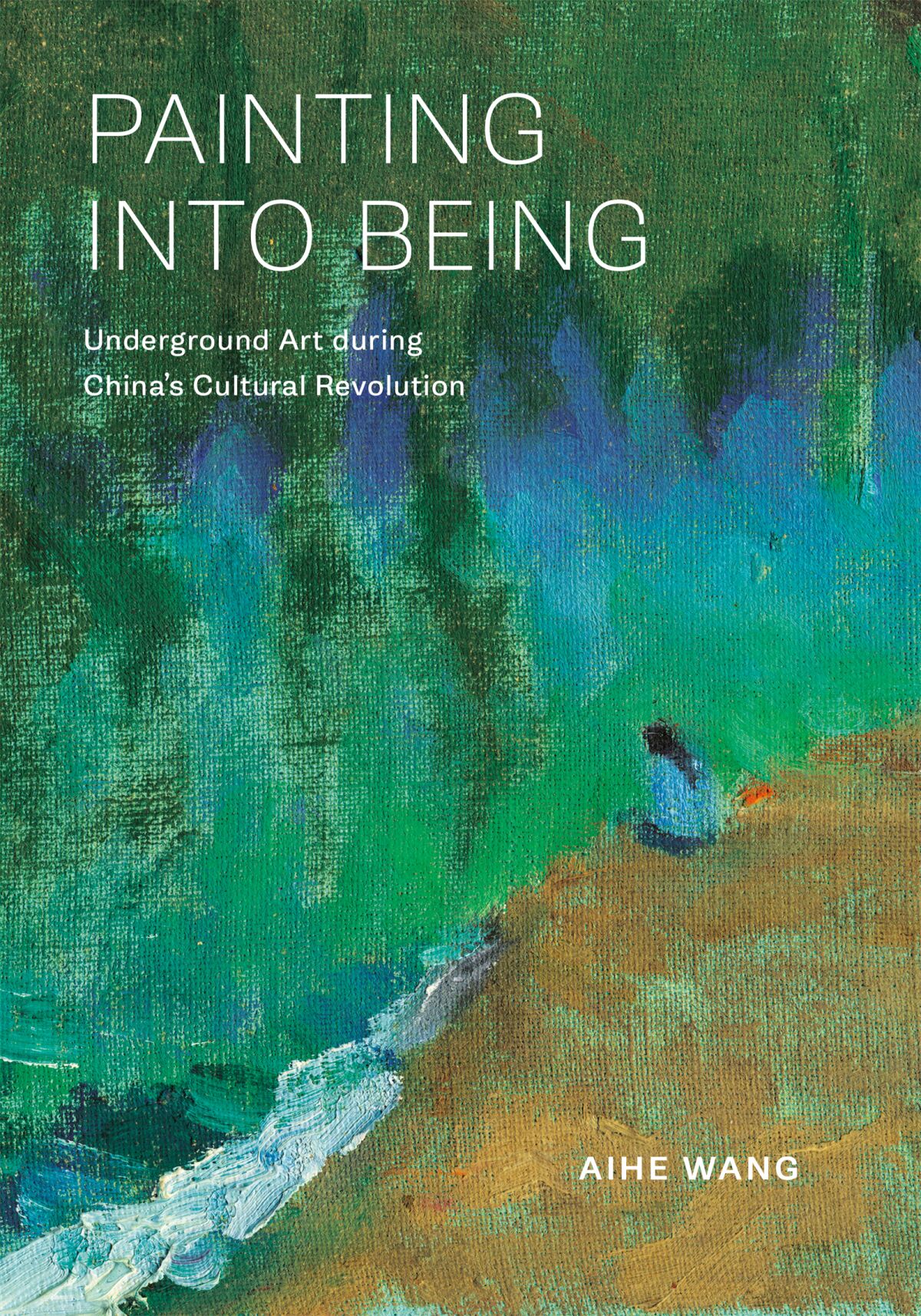
In advance of this week's Asia Center Author Book Talk, author Aihe Wang discusses her book Painting into Being: Underground Art during China’s Cultural Revolution in the interview excerpt below. Join us for her virtual talk Wednesday, November 5, 7:00 - 8:15 p.m. ET.
Could you give us an overview of your book? Painting into Being is about underground art during China’s Cultural Revolution. By underground art, I mean art produced and circulated secretively beneath the radar of the authorities. While analyzing underground art and culture in general, the book focuses in depth on the Wuming painting group, comprised of 15 or so artists, which was active in Beijing between 1962 and 1981. It discusses 97 of the group’s works, most of which I selected from over 1,000 paintings reproduced in the 13-volume Wuming Painting Catalogue (2009), which I compiled.
A typical example of the art discussed in the book looks like this: a small oil painting on paper or cardboard, portraying a landscape, flowers, a sunset, or moonlight. Why would a painting of moonlight – or flowers or trees or mountains or water – have to be produced and viewed underground? Most viewers today find it incomprehensible. To answer this question, my book sets these paintings into their historical and social context during the turmoil of the Cultural Revolution. It demonstrates in detail how they were produced in an underground collective, and how that collective practice acted on its historical and social context, forging alternative ways of being and thinking. By tracing and analyzing the artists’ unique aesthetic innovations, the book also shows how the Wuming group participated in global modernism – even in its clandestine isolation.
What drew you to this area of research? As the author, I hold a dual position. I was an active member of this underground group, and therefore felt a responsibility to write down our experience and history. Yet I am also a professional historian and anthropologist working in academia. In this intellectual role, I had a burning desire to understand the larger history and social-political structure against which we acted, persisted, and created, and which gave our art sense, meaning, and significance. In other words, I wanted to truly know the dialectical entanglement between our art and our world. So for this book project, I switched my research focus from ancient to modern China, and turned our art, community, and memory into my anthropological fieldwork.
What also drew me into this project was decades of reflection on the narratives of the very history that I lived and experienced. Fifty years after the ending of the Cultural Revolution, the public and scholarly understanding of its history has been shaped by two polarized master narratives. One narrative describes a great catastrophe of mass victimization, the other describes a great revolution of mass emancipation. Within both narratives, the existence of independent, critical agency has remained a dark abyss, pierced occasionally by a shooting star of a heroic individual, or a moment of political dissent quickly crushed. I believe underground art and art communities can help illuminate this little-explored abyss, because they evidence not a brief political dissent but a persistent aesthetic critique, an independent visual commentary on lived experience during the Cultural Revolution.
What was the question (or questions) that drove the creation of this book? If you had to distil it, what’s the central argument or theme readers should take away? The core question of the book is how art engages and critiques modernity, focussing in this case on underground art in relationship to Chinese modernity. My central argument is that the Cultural Revolution was not an alternative to capitalist or western modernity, nor what is often called the “China Model” or oriental exception; rather, it was an integral part and radical form of our common global modernity. And in confronting this radical form of modernity, Wuming art spoke directly against the lived experience of the Cultural Revolution; it enacted what Hannah Arendt called a “rebellion of the heart”, rebelling against the bulldozing of nature, the smashing of culture, and the assaulting of humanity. It also imagined modernity otherwise, inventing other visions of being modern, being human, and being in the world, thereby denying that “revolutionary modernity” was our sole and inescapable destiny.
From this case, we learn that art is not simply the product called artwork; instead, art is primarily and fundamentally a social action. When a scene of moonlight must be produced underground, we know that it has become the first and the last medium to generate and assert human agency. Readers will remember a poignant and complex case of art creating meaning, forging community, and asserting human agency even when forced underground.
How did you structure the research in this book? (chronologically, by theme, etc.) How did you decide to structure this way? This is a highly inter-disciplinary book and is accordingly structured by major themes. The introduction establishes the overall conceptual framework, connecting underground culture, Chinese revolution, global modernity, and world modernism. Chapter one, “From Zero to One”, is a historical chapter that explains how underground culture emerged. It chronicles how multiple underground art and literature groups germinated in isolated contexts, thrived temporarily, and crashed under torrents of revolutionary campaigns, and how they stubbornly rekindled again and again, eventually merging into an undercurrent of counterculture that persistently challenged Mao’s utopian project. When this undercurrent finally burst above ground and into public view in 1979, it led to the cultural renewal of the reform era.
With that history firmly established, the book then dives into three interrelated themes. Chapter 2, “Moonlight Sonata," explores how this underground culture invented private art and literature, in diametric opposition to overtly political official arts. Private art enacted a rebellion of the heart, against the state’s destruction of the private sphere and eradication of privacy. Images of (broken) homes and interiority articulated the emotional experience of the revolution, while reinventing a private refuge on paper in which the body and soul could subsist.
Chapter 3, “From Sand to Stone," analyzes the collective nature of the Wuming group, including its formation, composition, and function. It demonstrates how the group as a community created a clandestine form of mini-public, when and where the public sphere was non-existent and free assembly was strictly forbidden. The party-state depended on divide-and-rule politics, segregating people by class, work unit, gender, generation, and the urban-rural divide. Through such artificial divides, individuals were stripped of authentic human ties and personalities, each becoming an isolated and atomized grain of sand. Wuming’s members crossed all five divides to form a free assembly that stands out for its rare heterogeneous social diversity. Only in this mini-public of diversity could they celebrate human plurality and form human solidarity, both of which were eradicated above ground.
This mini-public was also critical to the group’s art practice, enabling the diverse artists to cultivate a shared aesthetics and a coherent artistic language, which I call a form of Chinese modernism. Chapter 4, “Artists at Large," demonstrates how this modernist art was created by hybrid appropriations of both western modernism and traditional Chinese aesthetics, the two taboos of official art doctrine. It analyzes four types of Wuming landscape painting: scenes of unpeopled nature; rural pastoral paradises; de-politicized cityscapes; and imperial edifices and gardens. All four became sites for projecting an independent vision supplanting the “revolutionary modern”, constructing alternative identities and inventing an alternative modern self. This creative invention acted as an aesthetic critique, challenging the official art doctrines of Maoist revolutionary modernity.
These three facets of underground culture – private art, a mini-public, and a shared aesthetics – together give rise to a modern self, an independent, self-constituting, and self-directing individual. The final chapter illuminates this “Painting into Being” of the independent modern self by examining Wuming’s portraiture. The Cultural Revolution was not just a political event, aiming simply to change power relations or control people’s behavior. Its goal was nothing short of changing human nature and people’s innermost being – how they feel, experience, and perceive the world. In Mao’s own words, it was a “great revolution deep down into the soul,” transforming the population into a mass of devout followers who would bring to earth his utopian design. Wuming’s many portraits, in contrast, manifested an autonomous self, who feels and thinks on one’s own, claiming the active agency to constitute one’s own inner-world, direct one’s own action, and project once’s own vision of the world. Portraying friends, portraying self, portraying strangers: these were activities of self-creation, projecting icons of independent selfhood and at the same time building inter-person communion and compassion.
What was the most challenging part of the research or writing process? The greatest challenge in writing was my compound subject position in relation to Wuming art. As both a participant in the past and a scholar in the present, I found myself alternating between subject and object of the writing. It was impossible to reclaim an authentic first-person voice from the past – as though that nineteen-year-old painter was finally getting to say what was on her mind. This anthropological self-awareness made it impossible to find my voice when facing my own paintings; I left a blank space and moved on to others’ works. Finally, I separated the person writing now as “I” and the person who painted then as “she.” This way, I disclaimed the authenticity of my interpretations as the original and only meanings of my paintings, while claiming my voice and perspective as an interpreter and scholar in the present.
Who do you imagine as the audience for this book? Being the first book in English about underground art in modern China, its immediate audience includes students, scholars, and other readers interested in art and in modern China. Yet Painting into Being interweaves history, theory, and lived experience to address essential themes of our current age: the China model, global modernity, fragmentation of the public sphere, human agency under threat. Its sharp angle is how art as creative action – both personal and communal action – engages grand universal struggles and dynamically participates in macro-history as an independent and critical element within it. The book therefore addresses readers across multiple disciplines, as well as anyone interested in the intersections of art, culture, and power.
What do you hope readers will be thinking about after finishing it? I hope readers finishing the book will think about its relevance to our life and world today. The book recounts a story that happened more than half a century ago. So much change has happened since then that we believe we are now in a totally different new world. But this new world, with all its technological glamour and economic rollercoasters, is not that new after all, for our global human condition has remained under threat just as it was back then. I see three similar threats in particular: 1) the capacity of those in power to intrude on people’s private lives; 2) the destruction of the public domain and our common world; 3) the control of inner life and the mind by the powerful few. Wuming took shape in the thick of Mao’s final revolution; we are now in the thick of a tipping point. But still, it was and is possible to act, then and now. Back then, fifteen artists took brushes to paint, to call forth private experience from the subconscious into the conscious, to articulate what seemed unspeakable so that it could be spoken and shared, and to share it with others by all means. Ours is a story of visual articulation, sharing visions, and generating human solidarity. These mundane actions of some ordinary people were far from acts of dramatic heroism. But they once broke the spell of fear and submission, isolation and paralysis. They once made a totality less total and humanity more humane. If it could be done then, it can be done now.
Do you have any stories from the process—fieldwork, archival finds, or even how you chose the title/cover—that might give readers a glimpse of how the book took shape? Finding the draft of the Wuming Manifesto was almost a miracle. Due to the danger of written words that were often used to incriminate people, Wuming artists left very sparse and fragmented archival documentation. The Manifesto was the group’s collective statement, drafted during a big group meeting to display at their first public exhibition in 1979. It was our most important text, and when I interviewed the artists during my fieldwork, they all believed it to be lost; it had been posted on a big board, which nobody had kept or photographed. But then the Inside-Out Art Foundation, which manages two of the elder painters’ estates, issued an exhibition catalogue in 2021 – after my book had entered the review process – that included a transcription of the Manifesto! Eventually, at my request, the Foundation kindly shared photographs of the original hand-written, four-page draft. As if the rediscovery of this lost text was not a great enough fortune, I slowly realized, while translating from the photographs, that the draft was in my own handwriting!