



Asia Center Author Ashton Lazarus Discusses Performing Transgression: Crowds and Bodies in Heian Japan
In advance of this week's Asia Center Author Book Talk, Ashton Lazarus discusses his book Performing Transgression in the interview below. Join us for Lazarus' virtual talk this Wednesday, September 30, 12:00-1:15 p.m. ET.
Could you give us an overview of your book? Performing Transgression is the first book in English devoted to non-elite performance (shomin geinō) in the Heian period (794–1185), which in modern Japan is often considered the golden age of classical Japanese culture. It focuses on the boisterous rhythms of dengaku dance and the carnivalesque feats of sangaku acrobatics, and to a lesser extent on popular songs (imayō) and puppetry (kugutsu). These forms had considerable impact on the medieval noh theater, but instead of bracketing them as precursors, I delve into their multisensory richness and social impact as a way to rethink the politics of culture in classical Japan. I approach these performances, which transgressed social, corporeal, and ontological boundaries and variously attracted and repelled elites, as opportunities to consider the mechanics of identification and relationality, arguing for the centrality of embodied practices in understanding premodern culture more broadly. The book seeks to reactivate archival materials (historical documents, visual sources, literary works) that have been separated by modern disciplinary boundaries and integrates them into a dynamic vision of the past.
What drew you to this area of research? The book is based on my doctoral dissertation, which in turn emerged from my interest in thinking about literary texts and social contexts together. When I entered graduate school, my plan was to research a medieval war epic called The Tales of the Heike, a text that likely started out as tales recited by blind lute musicians. I was reading fascinating scholarship by people like David Bialock and Hyōdō Hiromi, which uses literary analysis of the text to think about the social aspects of those who recited the tales and the wider communities for which they performed. As my focus shifted earlier in time and I started researching performance in the tenth, eleventh, and twelfth centuries, I was struck by how little work had been done on the materials I encountered, despite how fascinating they are. For example, when I first read An Account of the Dengaku in the Capital (1096), which narrates how dengaku performances shut down the flow of people and goods in the capital for several days before spreading to elites (who then put on their own performances), I was thrilled by the rich story it told about excess and interclass contact. The book is all about expanding on this fascination.
What was the question (or questions) that drove the creation of this book? How does our impression of Heian culture change when we approach it through documentation related to non-elite performance? I mean this question in two different ways. The first implies a “history from the ground up” approach that considers what we can learn about class, politics, and culture when we home in on the practices of non-elites. The second has to do with emphasizing performance in particular, as a way of doing things in the world and transmitting embodied knowledge. Focusing on this documentation raises questions about the importance of performance for aristocrats (whose daily lives were highly ritualized), and it furthermore relativizes what have been canonized as the enduring cultural pursuits of literary elites (The Tale of Genji, for example).
Related questions that I think about throughout the book are: How do we reconstruct the vanished past? In what ways can performance live on between the archive and the repertoire? What vectors of contact existed between elites and non-elites, between urban and rural populations? What sorts of boundaries did performers, farmers, courtiers, and emperors transgress, and why?
If you had to distill it, what’s the central argument or theme readers should take away?Throughout the book, I use archival documents—histories, diary entries, literary texts, images—to explore the form, content, and context of past performances. I argue that these works depict, in various ways and for countless purposes, performance’s ability to mediate a transgressive relationality between elites and non-elites. Performances of dengaku, sangaku and sarugaku, imayō, and kugutsu constitute a robust repertoire of boundary crossing and negotiation, and they demonstrate the breadth and diversity of Heian culture.
How did you structure the research in this book? How did you decide to structure this way? The book is divided into two complementary parts, “Crowds” (chpaters 1–4) and “Bodies” (chapters 5–7). This structure helped me tease out the different forms of identification triggered by transgressive crowd formations and bodily practices, while still enabling plenty of freedom within the parts. For example, part 1 is mostly focused on dengaku, but also explores audience and spectatorship across a few different forms and contexts; and part 2 focuses on sangaku/sarugaku acrobatics, imayō popular songs, and kugutsu puppetry as case studies of embodied practices. I arrived at this after a lot of trial and error. Alternate attempts included arranging the book by topic (each chapter explored a different topic related to non-elite performance), or narrating a more straightforward chronological history, but ultimately I liked the idea of each chapter existing in the space between larger themes (crowds and bodies) and concrete repertoires.
What was the most challenging part of the research or writing process? The book rests on scholarship written by literary scholars, historians, art historians, and ethnologists, in English and in Japanese, all throughout the twentieth century and into the twenty-first century. Even though my topic is relatively narrow, this is still a massive amount of scholarship. As a result, I struggled with the feeling that I had to read everything written about a particular text or historical figure before developing my own contribution. I eventually realized that I’d never be able to finish the book if I continued in this way, so I started prioritizing more recent research that seemed to respond to or integrate previous research, as well as the obvious “must read” texts from the past. As I discuss in the book’s conclusion, the scholarly examination of the past is ongoing and ever-changing,
Who do you imagine as the audience for this book? The main audience of the book is other scholars of premodern (especially classical or medieval) Japan, but I also tried to write in a way that would be appealing to performance studies scholars or cultural historians in general. Scholars of premodern Japan will find a novel take on the impact of non-elite performance during what is often perceived to be the golden age of Japanese court culture. Cultural historians and performance studies scholars will find a case study that explores the relationship between embodiment, transgression, and class.
What do you hope readers will be thinking about after finishing it? By becoming more familiar with the broad range of cultures in the Heian period, I hope my readers will become interested in rethinking archival “traces” in their own areas of study and time periods. As I discuss in the book, some things are more easily archived than others, and a more sensitive awareness about the mechanics of this “unarchiving” can help us come up with new understandings of the past.
Do you have any stories from the process—fieldwork, archival finds, or even how
you chose the title/cover—that might give readers a glimpse of how the book took
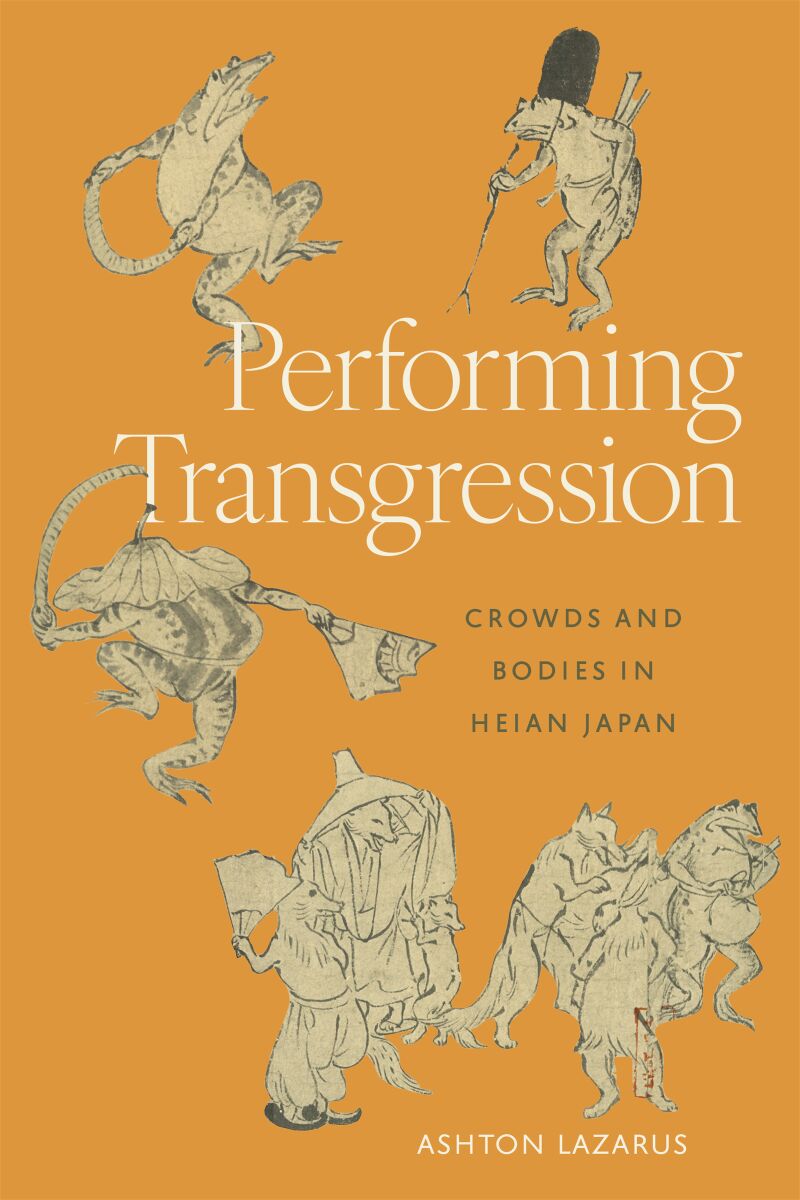
shape? I love the cover of my book. The cover designer, Regina Starace, did a phenomenal job with it, and there is also a bit of a story behind the animal images you see. I’d long been impressed by the frogs performing dengaku, which Regina arranged in the top-left of the cover. The images come a section of Scrolls of Frolicking Animals, one that is extremely well known in Japan and has received the designation of national treasure (kokuhō). The scrolls are held by Kōsanji, a temple in Kyoto, and as someone who is interested in art history but has no real training in related practical matters, I wasn’t sure how to go about requesting image-use permissions. All I knew was that there was no e-mail address posted on the Kōsanji website. So I got in touch with some colleagues who are knowledgeable about such things and they all replied the same way: send a request to the temple via fax, or better yet, via post. They also referred me to the North American Coordinating Council on Japanese Library Resources (NCC), which has an extremely helpful guide (with templates!) to making these requests. I used their template to create my request, and then fired up my department’s fax machine, which had not been used for so long that it immediately spat out several dated advertisements from local companies. I crossed my fingers and faxed the temple. A month passed with no response, so I decided to write them a letter as well. You can imagine by joy when, some weeks later—once I had basically given up on using the image on my cover—I received a response from the temple, via e-mail, with the permission form filled out and stamped. The moral of the story is that good old snail-mail still works, and that temples do have e-mail accounts, even if they don’t post the addresses online.