



Asia Center Visiting Scholar Zhiyou Han Discusses Paper Culture at the Imperial Court of China
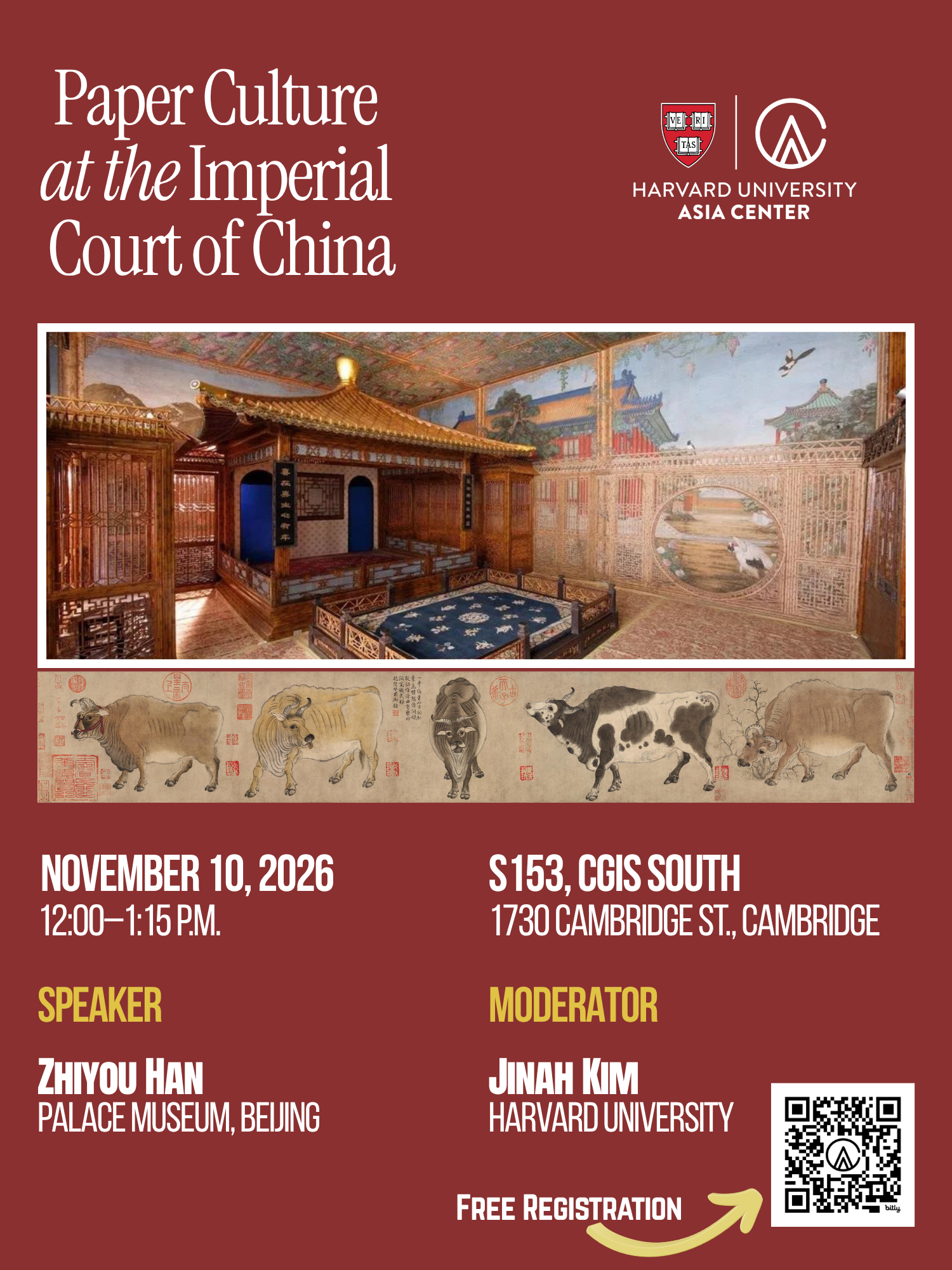
On Tuesday, November 10, 12:00-1:15 p.m. ET, the Asia Center will welcome Zhiyou Han, Visiting Scholar, Harvard University Asia Center and Associate Research Fellow & Conservation Specialist, Department of Conservation Standards of Cultural Heritage, Palace Museum, Beijing, who will be giving the talk "Paper Culture at the Imperial Court of China." Jinah Kim, George P. Bickford Professor of Indian and South Asian Art, Department of History of Art & Architecture, Harvard University will serve as moderator. Learn more about Han's research interests in the interview below and please join us Tuesday in Room S153, CGIS South, 1730 Cambridge Street for the event. Registration is appreciated.
Most of us think of paper as a simple flat surface for writing, but your research shows it played a massive architectural and decorative role in the Forbidden City. What is one mind-blowing example of how paper was used in the imperial court that will completely change how our audience looks at the medium? One of the biggest surprises is how extensively paper helped shape palace interiors. In the Forbidden City, paper covered walls and ceilings and served as window coverings, keeping out drafts while admitting light. Craftspeople also dyed, printed, or decorated these papers with gold, making them an integral part of a room’s appearance.
The Palace Museum in Beijing holds some of the world's rarest and most protected paper varieties. Without giving everything away before the talk, what is a fascinating discovery you've made while handling these artifacts that you are most excited to share with the audience?I am particularly excited to introduce papers that are works of art in their own right. Some papers in the imperial collection carry intricate designs, while others stand out for their color and luster. Even before anyone wrote on them, they were already beautifully finished objects.
One example in my talk is ciqing paper, which has a rich, deep blue color. Accounts of its manufacture describe repeated dyeing followed by further finishing and burnishing. The paper had to withstand repeated wetting and handling, so the choice of fibers and the preparation of the base sheet were crucial. What fascinates me is how beauty connects to material performance. We see this striking blue surface, but behind it is a craftspeople deep understanding of fibers, dyes, and how everything comes together.
Traditional paperhanging was essential to furnishing palace interiors, yet it's a craft many modern museumgoers know little about. Why should art enthusiasts and history buffs be fascinated by the intricate techniques of imperial interior decoration? For art enthusiasts, these techniques reveal the materials and skills behind elaborate decoration. For history enthusiasts, they bring us closer to the spaces in which people at court actually lived. Conserving these interiors today requires us to understand those traditional skills. A seemingly modest layer of paper connects architecture, art, and generations of practical knowledge.
Did emperors and court elites look for different qualities in their paper than traditional scholars and artists did? How did imperial prestige and personal taste dictate the production and selection of these handmade papers? There was considerable overlap. Both valued the quality of the paper and how it responded to brush and ink. Emperors could also be accomplished calligraphers, painters, and collectors, so imperial and scholarly tastes were often closely connected. At court, however, paper also had to meet expectations associated with status, ceremony, and particular uses.
A few examples from my talk show this. Coated and waxed papers decorated with gold and silver flowers reflect the court’s taste for elaborate craftsmanship. Imperial Xuan paper made for Chunhuaxuan has a dragon design hidden between its layers, which you can see when you hold it up to the light. The patterns, production marks, and even the way a sheet was made could all express imperial identity.
The court also commissioned imitations of celebrated papers from earlier periods. An emperor’s personal taste could therefore influence both decorative choices and efforts to recover the qualities of historic papers.
What is the main insight or takeaway from your talk that you hope will make attendees walk away seeing Chinese art and museum objects in a whole new light? I hope people leave with a broader sense of what paper can be. It can hold writing and painting, become part of an interior, support a work of art, or simply be admired for its own color, texture, and sheen. The next time they visit a museum, I hope they’ll ask not only what’s written or painted on a sheet, but also, “What kind of paper is this? How was it made? Why was it chosen?” Those questions help us notice the craftspeople whose work supports the artist’s, and they show how an object’s appearance today reflects a long history of making, use, repair, and preservation. Paper has a story of its own, and it’s worth listening to.