



A Conversation with Asia Center Author Helen Hardacre
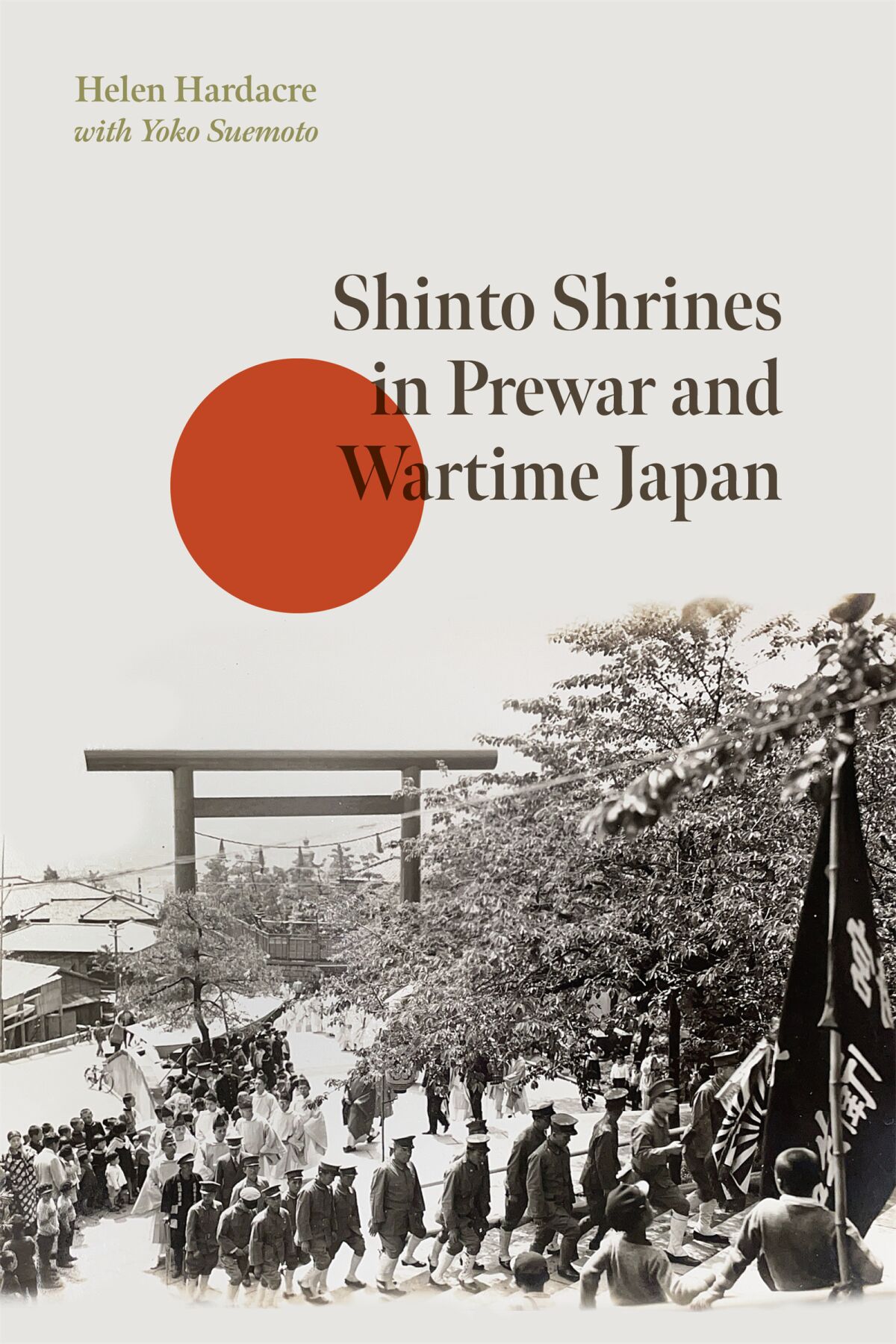
A Conversation with Asia Center Author Helen Hardacre
Helen Hardacre's book Shinto Shrines in Prewar and Wartime Japan examines the religious and social history of Shinto shrines, focusing on the economic, social, and ideological implications of State Shinto. Helen Hardacre argues that politicians regarded public funding of shrines as crucial for elevating their “dignity” and for curbing progressive thought and activism. Understanding the social and financial dynamics of both major and smaller shrines is key to comprehending State Shinto’s broader impact on Japanese society. This study employs a historical analysis using shrine records, personal diaries, contemporary literature, and government documents. It includes case studies contextualizing events at specific shrines within broader social and political change, personal accounts of priests and laypeople, and statistical analysis of funding patterns. Hardacre’s comprehensive approach provides valuable insights into the role of religious institutions in politics and ideology. By highlighting the nuanced experiences of smaller shrines, their priests, and associated laypeople, Shinto Shrines in Prewar and Wartime Japan enhances understanding of State Shinto’s reach and influence, contributing to broader discussions on the interplay between religion, politics, and society in modern Japanese history.
Purchase Shinto Shrines in Prewar and Wartime Japan at Harvard University Press
What first drew you into the research that would become your book?
There is a long history of research on State Shinto, but none of it probed the issue of public funding. Having researched Shinto and its history for around forty years, focusing on issues of relations between Shinto and state, I was struck by the lack of any study addressing how and why systematic public funding for shrines was created at the beginning of the twentieth century. That lack seemed to me to be a significant problem, and I wanted to investigate it. Another problem I wanted to address is the issue of religious experience in State Shinto. If, as much research has it, State Shinto resembled religion in some way, one would expect it to have a dimension of religious experience. I pursued that question in this study, alongside the question of public funding.
What was the question (or questions) that were driving the writing of this book?
I wanted to know what difference public funding made to shrines—which ones received funding? How much? Did the amounts change over time? What did they do with the money? How was the religious culture surrounding shrines affected by public funds? If, as much research has it, State Shinto resembled religion in some way, one would expect it to have a dimension of religious experience. I wanted to investigate that.
How did you structure the research in this book? (Chronologically, by theme ect) Why did you decide to structure this way?
This book is divided into four parts, each corresponding to one of the four decades when shrines were eligible for public funding (1906-1945). Each part contains a chapter addressing the system for shrines’ public funding during the decade and one or more chapters examining specific shrines or religious practices connected with shrines. Each part is followed by “Reflections,” a short summary of provisional conclusions. Chapters about the system of shrines’ public funding discuss which shrines received public funding, the criteria for eligibility, and the significance of receiving public funds. Each of these matters changed considerably over the thirty-nine years of the study. The chapters addressing specific shrines (mostly in Kanagawa Prefecture) discuss popular religious life at shrines during the decade, based on diaries kept by shrine priests and lay people. Shifting social attitudes towards shrines, a division of “haves” and “have-nots” among priests, government attempts to manipulate shrines, and a growing influence of the military influenced the changing character of shrines’ religious culture.
What was the most challenging part of the research or writing process?
I found it challenging to derive an overall picture from the mountains of documents I was dealing with.
Who do you imagine as the audience for this book?
People interested in questions about how and why a society comes to accept authoritarian government and the roles of religious institutions in that process.
What do you hope readers will be thinking about after finishing it? How and why a society comes to accept authoritarian government and the roles of religious institutions in that process.
Do you have any stories from the process—fieldwork, archival finds, or even how you chose the title/cover—that give readers a glimpse of how the book took shape?
Over a five-year period beginning in 2013, I travelled with my research assistant, Ms. Yōko Suemoto, to every prefectural library in Japan to consult the prefectural statistical yearbooks and collect their data on shrine fees, except for Tottori and Gifu Prefectures, where librarians had already removed the volumes from public use and substituteda digital copy, judging the originals too fragile to be handled. Once at a prefectural library, Ms. Suemoto and I would request permission to consult the prefectural statistical yearbooks of 1906 to 1945. This amounted to asking the librarians to place thirty-nine years’ worth of material on library trucks and allow us to take them to a table and gothrough each one. Librarians took this in stride, though it meant in some cases loading up 156 volumes (39 years x 4 volumes per year). Until we had visited about ten prefectures, we could not determine which items would prove to be standard and which were idiosyncratic to a particular prefecture. By the end of the second year, however, we had finalized our template and gained confidence in the collection method. By that time, unless there was something quite odd about a particular prefecture’s data, we could collect the data within a day. However, to compensate for problems of the earliest stage, it was necessary to revisit some of the prefectures we had visited at the start. This was true of Kanagawa Prefecture, the first one we visited, which proved to be the most problematic and required the most follow-up visits. Having started with Kanagawa, however, we had unknowingly experienced something of a baptism by fire and later were not unduly perturbed by difficulties encountered elsewhere. Iwate Prefecture provided one example of a problem so challenging that a follow-up trip to the prefecture was necessary. When Ms. Suemoto and I first visited the Iwate Prefectural Library in 2016, the statistical yearbook for 1940 stated that the prefecture had received 6,343,500 yen from the national government to support high-ranking shrines that year, a number so large that we knew of nothing like it. We were surprised at the time and checked and re-checked the number to be sure that we had not misplaced a decimal point or otherwise recorded the figure incorrectly. Yet there it was, and we had not been mistaken. Returning to the prefecture a year later, we realized from consulting a later volume that the yen sign was misplaced in the 1940 volume, and that the original text was lacking a decimal point, making the correct figure 6,434 yen, a number in line with the preceding and following years. Another curiosity in the Iwate data were the entries in the volume for 1938 concerning an expenditure for assistance to the shrine priests’ association. Up through 1933, this figure had never exceeded 1,000 yen annually, but suddenly it shot up into the hundreds of thousands and even millions of yen. Going back to those volumes, we found again that we had recorded the figures correctly, but the numbers themselves could not be correct. Assuming that numbers on this scalehad to be clerical errors, we went to previous volumes and searched for that series of numbers. There they were—in the accounting for prefectural bonds (kensai). In effect, a clerical error had resulted in transposing the figures for prefectural bonds into the line for assistance to the shrine priests’ association. Once we figured that out, we were able to resolve our records, and it became clear that Iwate Prefecture is not an outlier, nor does it show huge, unexpected discontinuities. While cases like this were challenging puzzles, solving them was immensely satisfying.