



A Conversation with Nikolas Broy
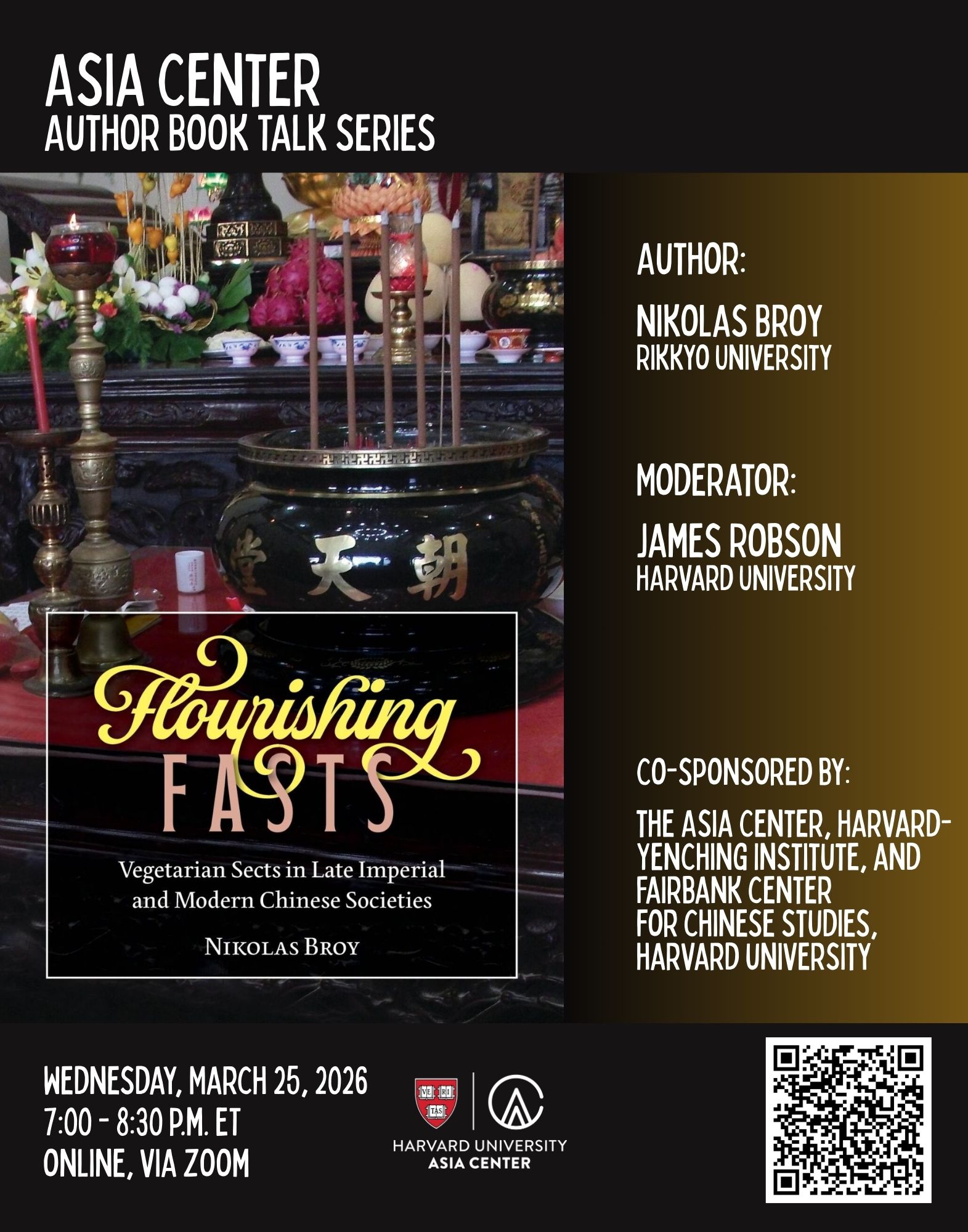
This week, we’re speaking with Nikolas Broy, author of 𝘍𝘭𝘰𝘶𝘳𝘪𝘴𝘩𝘪𝘯𝘨 𝘍𝘢𝘴𝘵𝘴: 𝘝𝘦𝘨𝘦𝘵𝘢𝘳𝘪𝘢𝘯 𝘚𝘦𝘤𝘵𝘴 𝘪𝘯 𝘓𝘢𝘵𝘦 𝘐𝘮𝘱𝘦𝘳𝘪𝘢𝘭 𝘢𝘯𝘥 𝘔𝘰𝘥𝘦𝘳𝘯 𝘊𝘩𝘪𝘯𝘦𝘴𝘦 𝘚𝘰𝘤𝘪𝘦𝘵𝘪𝘦𝘴. His book offers a new perspective on Zhaijiao (“vegetarian sects”), exploring how these communities have shaped—and been shaped by—the religious landscapes of late imperial China and modern Taiwan. Drawing on historical sources and ethnographic research, Broy challenges conventional interpretations of sectarian groups and highlights their central role in local society.
There will be an online book talk on March 25th, 2026 on𝘍𝘭𝘰𝘶𝘳𝘪𝘴𝘩𝘪𝘯𝘨 𝘍𝘢𝘴𝘵𝘴: 𝘝𝘦𝘨𝘦𝘵𝘢𝘳𝘪𝘢𝘯 𝘚𝘦𝘤𝘵𝘴 𝘪𝘯 𝘓𝘢𝘵𝘦 𝘐𝘮𝘱𝘦𝘳𝘪𝘢𝘭 𝘢𝘯𝘥 𝘔𝘰𝘥𝘦𝘳𝘯 𝘊𝘩𝘪𝘯𝘦𝘴𝘦 𝘚𝘰𝘤𝘪𝘦𝘵𝘪𝘦𝘴 . For more information click here.
Could you give us an overview of your book?
The book explores a set of sectarian groups in late imperial China and modern Taiwan that are usually referred to collectively as Zhaijiao, a Chinese term that can be translated as “vegetarian teachings,” “vegetarian religions,” or, as I prefer, “vegetarian sects.” The term encompasses three groups, the Longhuapai (“Dragon Flower Sect”), Jintongpai (“Gold Pennant Sect”), and Xiantianpai or Xiantiandao (“Former Heaven Sect”), all of which were established during the late Ming and early Qing periods, especially in southeastern coastal China. Practitioners are required to abstain from meat and other foods (including a group of five pungent vegetables, such as garlic and onions), as well as alcohol, a regulation profoundly influenced by Chinese Buddhism and Daoism. Because their foodways distinguished them from most people in society, these groups were often referred to as “vegetarians” by both sect members and outsiders.
The book examines Zhaijiao religious symbols, ideas, and teachings, as well as ritual practices, moral values, material artefacts, architecture, and everyday life, to explore the overall relevance of sectarian groups in the Chinese religious landscape more generally. The book is thus at once an introduction to the Zhaijiao and an analysis of religious life in Chinese sectarian groups since the 17th century, based on historical sources and ethnographic fieldwork data.
What drew you to this area of research?
My interest in the field of Chinese sectarianism was profoundly influenced by my teacher Hubert Seiwert, with whom I took many classes during my undergraduate and graduate studies. He once told me that he wanted to pursue a similar project to explore the history of the Zhaijiao in mainland China during the late 1980s, but due to the political circumstances at the time, this did not materialize. These limitations and ethical concerns drove me to conduct ethnographic fieldwork in Taiwan instead. In addition, I have always been interested in religion as practiced, or, as it’s sometimes called, “lived religion,” which also explains the broad scope of my analysis.
What was the question (or questions) that were driving the writing of this book?
The main question that stood at the beginning of the writing process was the feeling that Zhaijiao and other Chinese sectarian groups had been framed and interpreted by most researchers in ways that I felt were one-sided. Ultimately, there are two divergent interpretations prevalent in earlier scholarship: first, viewing the Zhaijiao and sects more generally as nonconformist dissenters and “secret societies” at the margins of society, and, second, to framing them as lay Buddhists or popular Buddhists whose aim was to develop a more Sinicized version of the Buddhist teachings outside the confines of monastic institutions and authority. I am not saying that these interpretations are entirely incorrect, but I felt they did not do justice to the diversity of Zhaijiao religious symbols, beliefs, and practices, and misrepresented their actual roles and functions in local societies. Accordingly, the individual chapters examine various aspects of Zhaijiao teachings and practices to demonstrate the important role of these sects in the local religious landscapes of late imperial China and modern Taiwan. Furthermore, the book stresses that they were also quite conventional and well-embedded in pre-established religious cultures.
If you had to distill it, what’s the central argument or theme readers should take away?
Probably three main arguments: First, that scholars should be more careful in applying labels, such as “Buddhist,” “Daoist,” or “Confucian.” Even though it’s a commonplace truth that reality is more complex than analytical frameworks and concepts, scholars need to be more attentive to create more balanced interpretations. Secondly, that sectarian groups in Chinese religious culture are not necessarily nonconformist dissenters or violent rebels, but, more often than not, are well-integrated into their respective local cultures. And thirdly, I insist that sectarians are not lay practitioners, as most previous scholarship posits. By calling them lay Buddhists, scholars inadvertently adopt the perspective of the dominant religious institutions (i.e., monastic Buddhism) and measure other religious practitioners against this default model. I think it is crucial to acknowledge their religious agency, which would be erased by subsuming them into the larger, dominant category of Buddhism. No one would do the same thing in other contexts, such as claiming that Protestants are merely lay Catholics, because they reject certain ideas and institutions of the Roman Catholic church. So why do it here?
How did you structure the research in this book? (Chronologically, by theme ect) Why did you decide to structure this way?
The book is structured thematically in three parts. I felt this was the best way to present diverse perspectives on Zhaijiao from various angles. The first part addresses conceptual issues in the study of sectarian groups more generally, and it explores the Zhaijiao’s history from late Ming Fujian and Zhejiang to contemporary Taiwan. Part two explores the diverse religious symbols, ideas, practices, artifacts, and moral values used in Zhaijiao teachings, practices, and architecture. I demonstrate how deeply vested in conventional Buddhist, Daoist, and Confucian ideas and symbols, as well as more generally understood “cultural logics” the Zhaijiao actually are. Part three looks into the embeddedness of the Zhaijiao in local life. Drawing on fieldwork data and materials from various religious surveys in Taiwan conducted by the Japanese colonial authorities and the KMT regimes in the 1950s and 1980s, I show that Zhaijiao temples were and still are important sites of local religious, cultural, economic, and political life.
What was the most challenging part of the research or writing process?
To bring the three different dimensions of narrow case study, overall context, and significance to the larger field, and my theoretical ideas together without exceeding the word count too much was, without doubt, the most challenging part of the writing process.
Who do you imagine as the audience for this book?
Although the empirical scope of the book seems rather narrow at first glance, I hope that my discussion of conceptual issues and the diverse perspectives on the social and cultural history of the Zhaijiao as intrinsic elements of late imperial China and modern Taiwan makes it appealing to a broad range of readers interested in religion, social and economic history, and cultural history of Chinese societies. Because I use this case study to further develop the scholarly understanding of sectarianism, I believe the book might also appeal to readers interested in the broader field of religious studies.
What do you hope readers will be thinking about after finishing it?
I chiefly hope readers and future researchers will be inspired to further the academic understanding of the diversity of sectarian groups. Even if the practitioners themselves identify as Buddhist, my analysis shows that the symbols, beliefs, and practices they use are far more diverse than the label “Buddhist” can ever hope to convey. Therefore, I think it is critical to think outside established analytical boxes, such as Buddhism, Daoism, and Confucianism. They may be helpful for understanding monastic Buddhism or communal Daoism, but they are of limited value for analyzing sectarian groups and many other religious contexts. There, many practitioners tend to create novel, sometimes unconventional syntheses by drawing on diverse religious symbols, beliefs, and practices. Of course, most researchers are well aware that empirical reality is always more complex than scholarly theories and frameworks; yet I think it’s time to reflect this commonplace truth in academic theorizations of religions and religious groups.
Do you have any stories from the process—fieldwork, archival finds, or even how you chose the title/cover—that give readers a glimpse of how the book took shape?
Fieldwork demands a specific kind of personal endurance. My journey into the Xidetang (Western Virtue Hall) in Tainan was actually a seven-year saga, on-and-off. During my 2010 and 2016 field trips, my primary “contact” was an aggressively barking dog that barred any hope of entry. With no doorbell and no way to reach the inhabitants by phone, I feared the doors would remain closed to me indefinitely. When I returned to Taiwan in 2017, I decided to give it a final try. This time, I succeeded. I was welcomed wholeheartedly by the temple leader, who provided not only invaluable information but also several cups of fine black tea.