



Emily Baum and Albert Wu Discuss Uncanny Beliefs: Superstition in Modern Chinese History
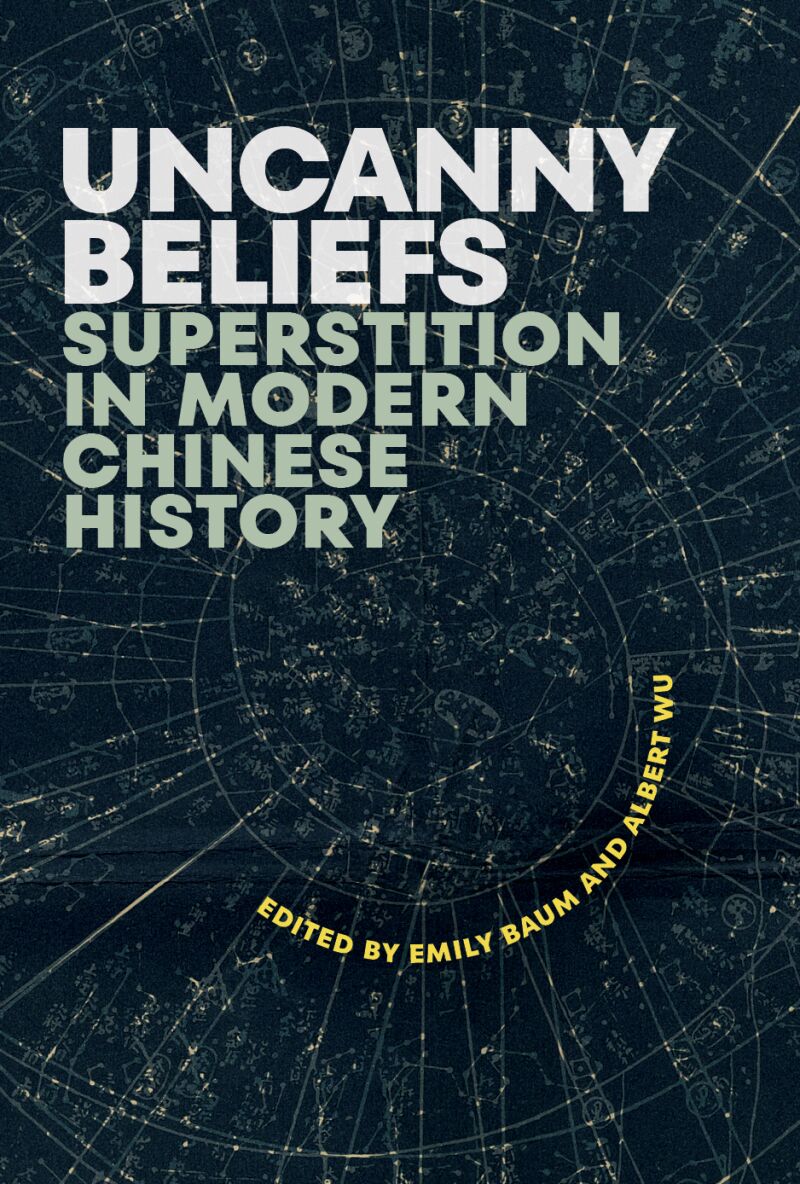
In advance of next week's Asia Center Author Book Talk, editors Emily Baum and Albert Wu discuss the book Uncanny Beliefs: Superstition in Modern Chinese History in the interview below. Join us for their virtual talk Wednesday, October 7, 6:30 - 8:00 p.m. ET.
Could you give us an overview of your book?
Uncanny Beliefs: Superstition in Modern Chinese History explores how “superstition” became such a powerful and contested category in modern China. The chapters take readers from nineteenth-century encounters with European missionaries and travelers to Republican-era experiments in psychical research, Maoist campaigns against household rituals, and contemporary online fantasy fiction.
Across these settings, we ask how certain practices came to be labeled superstitious, what that label meant for those who engaged in such acts, and how communities responded. The book also explores why practices targeted for elimination remained meaningful even when the rhetoric of “science” had achieved ideological power: they offered ways to care for others, navigate uncertainty, build relationships, and imagine more auspicious futures.
What drew you to this area of research?
Albert: I came to this project through my work on Christianity and European missionaries in China. Again and again, I encountered missionaries calling the practices around them “superstitious.” What interested me was how much work that word could do. It could dismiss a healing practice, discredit a religious community, or explain why China supposedly needed foreign intervention.
Yet the people using the term were often far less consistent than they appeared. Practices condemned in one setting could be defended in another, and disputes over superstition were unfolding within Europe as well as between Europeans and Chinese. That led me to ask how these judgments emerged and traveled. This volume offered an opportunity to connect those questions with histories of medicine, gender, politics, and everyday life across a much longer period.
Emily: I have always been drawn to topics that challenge the demarcation between reason and unreason. My first book on changing understandings of mental illness in Chinese history showed how concepts that might at first appear natural, universal, and stable are in fact socially constructed and historically contingent. Like Albert’s work on Christianity, my earlier research also showed how Protestant missionaries disparaged Chinese treatments for mental illness as superstitious – yet missionaries’ own treatments, which were supposedly based in science, were neither more empirical nor more effective than those used by Chinese families. In fact, missionary practices like exorcisms were often more “superstitious” (by their own measure) than the ones they were targeting among the Chinese population!
What was the question—or questions—that drove the creation of this book?
One central puzzle was why successive generations of Chinese reformers and political leaders treated superstition as such an urgent problem, even as they disagreed about so much else. What made the notion of “superstition” seem threatening to missionaries, Nationalists, and Communists alike? And how did the meaning of the word change as it passed among them?
We were equally interested in the people whose activities attracted the label. Why did they continue to consult diviners, conduct rituals, or seek spiritual healing despite criticism and repression? How did they defend or adapt those practices? Bringing these questions together allowed us to examine both the ambitions of people who sought to eliminate superstition and the everyday relationships that made those efforts so difficult.
If you had to distill it, what’s the central argument or theme readers should take away?
Battles over “superstition” have taken center stage in the modern history of China. Missionaries, reformers, and revolutionary governments made its eradication central to their visions of progress. Yet they never agreed on precisely what superstition was. Its meaning shifted with their ambitions: practices condemned as backward could later be investigated as science or celebrated as cultural heritage.
We argue that this instability helps explain the category’s power. Calling something superstition gave authorities an unassailable justification for intervening in everyday life, often at the expense of people whose ideas and ambitions challenged their own. Battles over the label thus became struggles over who could exercise authority and whose vision of China’s future would prevail.
How did you structure the research in this book? How did you decide to structure it this way?
The volume follows a broadly chronological arc, beginning with nineteenth-century debates about proper and improper religion and moving through the Republican and Maoist periods into the contemporary world. Within that chronology, the chapters approach superstition through different subjects and methods, including religious history, medicine, gender, literature, and anthropology.
This structure allows readers to follow changes across political regimes while noticing recurring problems. Questions about caregiving, local authority, and the boundaries of science appear in very different historical settings. The range of contributors also helps us avoid reducing the story to government policy alone. Readers encounter superstition in homes, religious communities, marketplaces, and digital spaces, as well as in official campaigns.
What was the most challenging part of the research or writing process?
We began talking about the project before COVID, then decided to hold two international conferences—one in Irvine and one in Taipei—as the pandemic was raging. Bringing people together under those circumstances was challenging enough, but as with any edited volume, the hardest part was getting all the papers across the finish line. Contributors were navigating very different circumstances, and keeping the volume moving required patience and persistence. Emily was heroic in keeping everyone on task. The book owes a great deal to her determination and care as an editor.
Who do you imagine as the audience for this book?
We hope the book will speak to readers interested in modern China, religion, and the history of science and medicine, as well as students encountering these subjects for the first time. The individual chapters offer entry points through topics as varied as spirit writing, women’s religious lives, fortune telling, and fantasy literature.
The larger questions also extend beyond China. Anyone interested in why certain beliefs command authority while others attract ridicule will find something here. Superstition is a familiar word, but looking closely at its history unsettles much that we take for granted about what it means to be modern.
What do you hope readers will be thinking about after finishing it?
We hope readers will become more attentive to what gets lost when we dismiss a practice as superstition. Behind the label may be a relationship of care, a source of livelihood, a way of managing uncertainty, or a community’s understanding of its place in the world. Understanding those dimensions helps explain why campaigns against superstition so often failed to achieve what their organizers intended.
We also hope readers will reconsider the expectation that modernization inevitably makes these practices disappear. The book shows people continually adapting so-called superstitious acts to new institutions, technologies, and circumstances. Their persistence is part of modern history, and it deserves explanation rather than surprise.
Do you have any stories from the process that might give readers a glimpse of how the book took shape?
Albert: One of my fondest memories is our first in-person gathering in Irvine. We were all masked and taking the necessary pandemic precautions, but after so many hours of Zoom calls and virtual meetings, it was wonderful simply to be in a room together. Conversations could continue over a break instead of ending when someone closed a laptop. That gathering gave the project a sense of shared purpose that had been harder to find on screen, and reminded me how much of a collaborative book takes shape through conversation.
Emily: Like most edited volumes, Uncanny Beliefs emerged out of long email threads and even longer Zoom meetings. But the two times the contributors were able to come together in person, first in Irvine and then in Taipei, made all those online conversations worth it! I remember specifically one conversation outside a coffee shop at the Academia Sinica, where everyone brainstormed ideas and gave feedback on an early draft of the introduction. All of their comments shaped the volume in meaningful ways.