



An Interview with Asia Center Author Mengxiao Wang
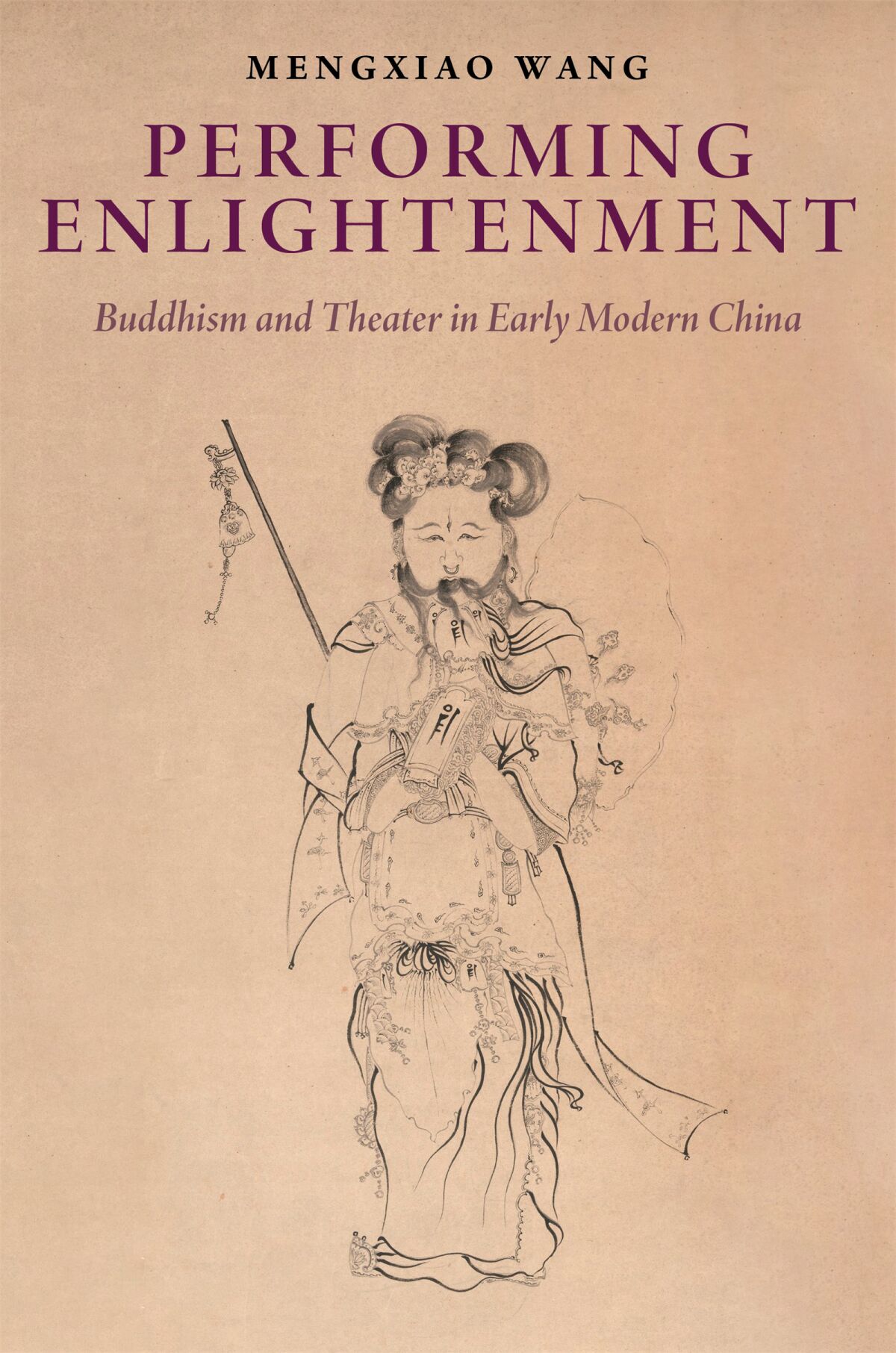
Asia Center Author Mengxiao Wang Discusses Performing Enlightenment: Buddhism and Theater in Early Modern China
In advance of this week's Asia Center Author Book Talk, Mengxiao Wang discusses her book Performing Enlightenment. Join us for her virtual talk this Wednesday, September 23, 12:00-1:15 p.m. ET.
Could you give us an overview of your book? The book examines how Buddhist clerics and laity engaged with and drove innovations in theater during the late Ming and early Qing dynasties, when a major revival of Buddhism coincided with a surging fascination with theater. Far from merely serving as a medium for conveying religious teachings and practices, drama became a source of deep concern for Buddhists due to the perceived tension between spiritual discipline and worldly entertainment. Drawing on an extensive range of sources, including clerical sermons, scriptural commentaries, temple gazetteers, morality books, literati prose, and dramatic texts and paratexts, the book argues that Ming–Qing Buddhists negotiated this tension by transforming theater into a creative mode of devotional practice. Consequently, playwriting, stage performance, and theatergoing could all be reimagined as legitimate pathways to spiritual enlightenment.
What drew you to this area of research? I came to this project through two longstanding interests: Chinese theater and Buddhism. I first fell in love with traditional Chinese theater in high school. As an undergraduate at Beijing Normal University, I participated in activities organized by the university’s Kunqu Opera Society. Under the guidance of Professor Guo Yingde, I wrote my MA thesis on theories of theatrical performance in the Ming dynasty. During that research, I encountered a number of Buddhist discourses on acting and spectatorship, although I did not yet have the opportunity to explore them fully.
The two interests came together more clearly after I began my doctoral studies at Yale. During my first summer in 2013, I attended a Chan Buddhist retreat at Bailin Monastery in Zhao County, Hebei Province, where I watched Transmission of the Lamp (Chuandeng), a Huangmei opera initiated by the late Chan master Jinghui. I was deeply moved by the performance, and the experience also deepened my personal engagement with Buddhism. It led me to ask how people in premodern China who were committed to both Buddhism and theater understood the relationship between them.
When I returned to Yale after that summer, I discussed the possibility of developing this interest into a dissertation project with my PhD advisor, Professor Tina Lu. Tina was very supportive and encouraged me to take courses in Buddhist studies and to work closely with Professor James Robson on one of my qualifying-examination fields, which focused on the social history of Chinese religions. This training eventually led to my dissertation on Buddhism and theater in China, which I later turned into this book.
What was the question (or questions) that drove the creation of this book? Early in my research for this project, a friend asked me a question that stayed with me: how much of my interest in Buddhism came from the literary beauty of Buddhist scriptures and writings? The friend also wondered whether, as a lay Buddhist, I felt any conflict in continuing to watch Chinese opera, and even to sing arias from Kunqu excerpts such as Longing for Worldly Pleasures (Sifan), in which a Buddhist nun yearns for secular life. These questions made me more conscious of a tension within my own interests: between Buddhist suspicion of sensual and literary pleasures, on the one hand, and my deep attraction to theater and literature, on the other.
Later, I began to recognize a similar tension in texts from late imperial China. Buddhist monks such as Zhida and lay practitioners such as Tu Long encountered harsh criticism for writing plays. Yet they did not simply abandon theater. This led to the central questions of the book: How did Chinese Buddhists negotiate the apparent conflict between religious discipline and theatrical activity? And in the process, how did they transform both Buddhism and theater?
If you had to distill it, what’s the central argument or theme readers should take away? The book’s central argument is that Chinese Buddhists did much more than use theater as a vehicle for transmitting religious teachings. They reimagined the people, texts, practices, and spaces that made theater possible. Playwriting could become a form of buddha-work; a dramatic text could be produced, circulated, and read as a sacred book. Actors could become models—and even teachers—of detachment and awakening, while spectators could be repositioned as ritual participants and disciples. Through these transformations, the theatrical stage itself could become a site of Buddhist practice and enlightenment.
I describe this process as a “productive tension” between Buddhism and theater. Buddhist concerns about theater’s moral dangers did not simply prevent practitioners from engaging with it. Instead, those very concerns prompted them to rethink what theatrical writing, acting, and spectatorship could do, creating new possibilities for both Buddhist practice and theatrical culture. Theater thus became not merely a representation of enlightenment, but a medium through which enlightenment could be enacted and experienced.
How did you structure the research in this book? (chronologically, by theme, etc.) How did you decide to structure this way? The book is organized thematically rather than strictly chronologically. The first two chapters establish the broader conceptual framework. Chapter 1, “Forbidding Theater,” examines Buddhist prohibitions against playwriting, acting, and theatergoing, while Chapter 2, “Philosophizing Theater,” explores how Buddhist masters nevertheless used acting and spectatorship as metaphors for detachment and awakening. The next three chapters turn from broad religious discourses to the production and reception of two Buddhist plays, Tu Long’s Tanhuaji (The Udumbara Flower) and Zhida’s Guiyuanjing (Mirror of the Return to the Origin). Chapter 3 examines how playwriting allowed the author to fashion himself as a buddha-like figure; Chapter 4 considers how a drama could be reformulated as a scripture-like text; and Chapter 5 explores how performance could be ritualized, while also comparing the playwrights’ ideals with the plays’ later staging histories. The coda moves to the present through a Buddhist-themed performance near the Shaolin Monastery. I chose this structure because it allowed me to begin with the apparent conflict between Buddhism and theater and then examine how Buddhists negotiated that tension through religious discourse, textual production, and theatrical performance.
What was the most challenging part of the research or writing process? Two aspects of the project were especially challenging. The first was developing Chapter 2, “Philosophizing Theater.” The subject appeared only briefly in my dissertation, but my committee member, Professor Eric Greene, recognized its potential and encouraged me to develop it further. During my postdoctoral fellowship at UC Berkeley’s Numata Center for Buddhist Studies, conversations with Professors Robert Sharf and Ling Hon Lam helped me think more deeply about the relationship between Buddhist philosophy and theatricality. After I joined USC, conversations with my colleague Jessica Zu further sharpened my understanding of the material’s philosophical dimensions. Because my original training was primarily in Chinese literature and theater, bringing theater studies into sustained dialogue with Buddhist philosophy required a great deal of time and care. But completing this chapter was also one of the most rewarding parts of writing the book.
The second challenge was reconstructing the performance and reception histories of plays from fragmentary evidence. A printed dramatic text may survive for centuries, but performances disappear as soon as they end. Moreover, the staging regulations written by playwrights tell us how they wanted their plays to be performed, not necessarily what actually happened in the theater. I therefore brought together different kinds of sources, including woodblock illustrations, temple architecture, later performance manuscripts, and paratexts produced by authors, publishers, and readers. These materials allowed me to trace how the plays moved from page to stage while remaining attentive to the gap between prescription and practice.
Who do you imagine as the audience for this book? I see the book’s primary audience as scholars and students of Chinese literature, Buddhism, religious studies, and theater and performance studies. At the same time, I hope it will speak to readers beyond these individual fields. The relationship between religion and theater is by no means limited to early modern China: musical and dramatic performance remains an important part of religious life around the world. By exploring how playwriting, acting, and theatergoing could be reimagined as various forms of devotional practice, the book may therefore also interest theatrical and religious practitioners, as well as general readers curious about the intersections of art, religion, and everyday life. I have used some of the materials and translations from the book in my undergraduate courses at USC, so I also hope that instructors will find parts of it useful in the classroom.
What do you hope readers will be thinking about after finishing it? I hope readers from different fields will come away from the book with different questions. Above all, I hope they will reconsider the familiar assumption that religious devotion and theatrical entertainment necessarily stand in opposition to each other. The Buddhists discussed in this book did not simply choose between rejecting theater and embracing it. Instead, the tension between Buddhism and theater prompted them to reimagine both traditions and to create new forms of writing, performance, and religious practice. More broadly, I hope readers will think about artistic media as more than vehicles for transmitting religious teachings. When Buddhist ideas moved onto the dramatic page and stage, theater helped reshape how Buddhism could be written, embodied, practiced, and experienced. The boundaries between religion, literature, and performance are not fixed; they are continually negotiated by the people who move among them.
Do you have any stories from the process—fieldwork, archival finds, or even how you chose the title/cover—that might give readers a glimpse of how the book took shape? In 2017, when I had just begun writing my dissertation, I attended the Shaolin Zen Music Ritual, an open-air performance in a mountain valley near the Shaolin Monastery. What struck me most were five monklike figures seated in meditation around the stage. They remained almost completely motionless throughout the performance, and I assumed that they were monks from nearby Buddhist monasteries. When I returned to the site in 2023 while completing the book, I contacted the company and interviewed several of these performers. Only then did I learn that they were local farmers who worked other jobs during the day and performed in the show at night. One of them, Mr. Liu, told me that while meditating onstage, he felt “a buddha sitting in my mind” and became unaware of the passage of time until the performance ended. His words touched me deeply. This encounter helped me see that “performing enlightenment” was not merely an idea found in premodern texts. The possibility that performance might become a form of Buddhist practice and perhaps even an experience of awakening remains alive in the present.