



Russell Burge on The Promised Republic: Developmental Society and the Making of Modern Seoul, 1961–1979
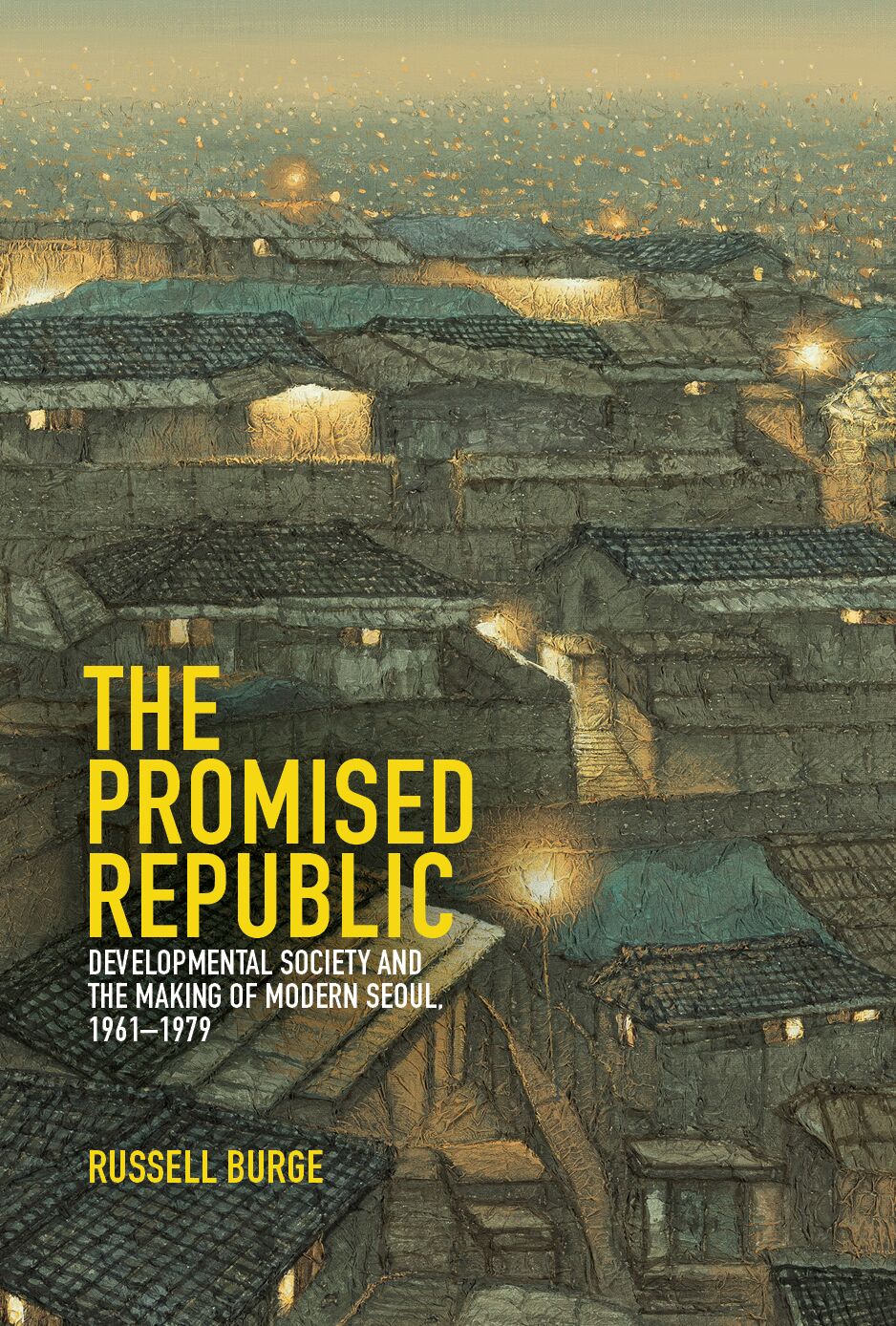
In advance of this week's Asia Center Author Book Talk, author Russell Burge discusses his book The Promised Republic: Developmental Society and the Making of Modern Seoul, 1961–1979 in the interview below. Join us for his virtual talk Wednesday, November 18, 12:00 - 1:15 p.m. ET.
Could you give us an overview of your book? The Promised Republic is a history of Seoul in the 1960s and 1970s. In these decades millions of people migrated to the city, and the vast majority of them made their homes in communities known as p’anjach’on, or shantytowns. P’anjach’on were built all throughout Seoul—on parkland, on mountaintops, along levees and other infrastructure—and they came to dominate the landscape of the city and play a major role in its politics. The Promised Republic reconstructs the history of shantytown communities through a range of materials including interviews, memoirs, newspapers, journals, photographs, ethnographic fieldnotes, National Assembly minutes, and other official as well as unofficial sources. The book’s particular focus is on how shantytown communities staked out claims to the city and, in so doing, became central players in the history of South Korean development.
What drew you to this area of research? For as long as I can remember, I’ve been interested in cities and the forces that animate them. I did my undergraduate work in Los Angeles and shortly afterwards moved to New York City and Seoul. My early experiences in South Korea—where I worked as an English teacher and wrote articles on the side as an art critic—made me particularly interested in the dynamics that undergirded urban redevelopment and urban inequality.
As a master’s student in Harvard’s Regional Studies East Asia Program I received my first formal training in Korean history, and I was lucky enough to have a mentor—Carter Eckert—who opened me up to the power of history to answer a number of my deeper intellectual questions. I received my Ph.D. in History from Stanford where I studied under Yumi Moon, who advised me on a doctoral dissertation focusing on the development of Seoul in the 1960s and 1970s. This dissertation became the basis for my book project. I was a postdoctoral associate at the Council for East Asian Studies at Yale from 2019-2021, at which time Hwansoo Kim served as my faculty host. During this period I sharpened the project’s focus on the politics of housing, and pushed my research more solidly into the 1970s.
One thing made evident to me during my graduate training was the relative paucity of research on Korean history after 1945, and after the Korean War in particular. Simultaneously, it was clear that the so-called “Park Chung Hee Era”—the years from 1961 to 1979 when Park Chung Hee ruled over South Korea as a strongman—had left a deep impression on the national consciousness and continued to impact South Korean politics today. Some aspects of this era had received careful scholarly attention—most especially industrial policy and the history of the student and labor movements—but there was a larger story of urbanization and social transformation that had been largely unexplored.
What was the question (or questions) that drove the creation of this book? My research was driven by an interest in what the history of South Korea’s rapid development looked like up close, to ordinary people. I knew that the urban poor were central players in this history—they are written about in literature from the time period, and became an object of interest for activists and community organizers—but I was surprised that there was no comprehensive study examining their lives or communities.
Once I began to approach the history of development through this lens, a number of additional questions presented themselves. Scholarship on the postcolonial era often focuses on the conflict between a strong authoritarian state on the one hand and an insurgent civil society on the other, but this framework did not seem particularly helpful for understanding shantytown politics. P’anjach’on residents risked life and limb to defend their communities and fought fiercely to shape the direction of developmental policy—but they did not, as a group, challenge the state’s authoritarianism or its fundamental legitimacy. Shantytown communities were organized through a number of local associations—most notably women’s associations—that helped to organize protest, and they actively sought media attention to leverage public sympathy. These struggles, however, were largely disconnected from the institutionalized civil-society movements of the 1960s and 1970s. Rather, they constituted a separate arena that I term “developmental society,” referring to a field of protest and social action in which urban residents sought to shape and lay claims to development on the ground.
If you had to distill it, what’s the central argument or theme readers should take away? Often when we speak of development we’re actually talking about a bundle of things. Economic growth, industrialization, and rising standards of living are a part of this conversation, along with—especially in the postcolonial world, and certainly in South Korea—the promise of a more dignified life for ordinary people. Above all, what I hope to show in the book is that such promises were not freely granted, but had to be fought for. To the extent poorer South Koreans did come to attain better lives for themselves and for their families, these gains were not simply handed to them by the Park government, but were rather secured and defended through struggle.
While carrying out research for the book, it became clear that even in the 1960s and 1970s people spoke of national development in contradictory terms. One tension I focus on at length is the tension between disciplinary developmentalism, which promised orderly and affluent cities, and populist developmentalism, which promised radical uplift for South Korea’s poor. Disciplinary and populist developmentalism offered distinct visions the developmental future—but in this space of contradiction and incoherence, shantytown residents were able to fight for increased opportunity for themselves and their communities.
How did you structure the research in this book? (chronologically, by theme, etc.) How did you decide to structure this way? The project is structured both thematically and chronologically. The first chapter focuses on the history of rural-urban migration in South Korea, highlighting the significance of land reform in the 1950s to the rural exodus that followed and led to the formation of Seoul’s shantytowns. The second chapter examines the amnesty promises extended to shantytown communities by Mayor Kim Hyŏnok in the lead-up to the elections of 1967, looking at both the populist logic that motivated these promises as well as the fallout that ensued once they were rescinded. The third chapter focuses on the so-called Kwangju Complex, a resettlement site for the urban poor that was created in the lead-up to the elections of 1971. The fourth chapter looks at the history of state housing in Korea with a particular focus on the Citizen Apartments program, also created in the lead-up to the 1971 elections. The fifth chapter examines the history of urban redevelopment in South Korea, focusing on redevelopment in the 1970s with an eye toward understanding the joint redevelopment (haptong chaegaebal) regime that ultimately took shape in the 1980s.
Woven throughout these chapters are two major historical changes. The first is economic growth, which created new pressures on p’anjach’on while simultaneously introducing new wealth and new divides to shantytown communities. The second is the shift in urban policy—undertaken in response to persistent shantytown protest—to a posture of material cooptation of shanty owners. This shift began in the redevelopment regime of the 1970s but culminated in the joint redevelopment practices of the 1980s, which divided p’anjach’on between owners and renters and set the stage for some of the most explosive conflicts over urban displacement in the late twentieth and early twenty-first century.
Who do you imagine as the audience for this book? The Promised Republic will be of interest to students of Korean history as well as East Asian history and postcolonial history more broadly. The book will be relevant to those with an interest in urban history, urban inequality, housing, international development, authoritarianism, and the politics of dissent.
It is also my hope that the book will of interest those curious to understand contemporary South Korean society at a deeper level. So much genre-defining media exists now about the struggle to survive under South Korean capitalism—Parasite, Squid Game, and Concrete Utopia are all dark allegories built around this theme—and we need scholarly work that contextualizes this struggle without exoticizing or romanticizing it. I hope that The Promised Republic can provide a meaningful contribution in this regard.
What do you hope readers will be thinking about after finishing it? One of the real pleasures of writing is the opportunity to be surprised by one’s audience—I look forward to seeing what readers bring to the material that I myself might not have imagined or anticipated.
While my goal in this research was neither to praise nor censure the Park government, throughout my research I was repeatedly struck by the brutality of the state and the ruling Democratic Republican Party in dealing with shantytown communities, and I suspect this will stand out to readers as well. Above all, I hope readers take away an appreciation for the complexity of shantytown lives, along the dignity, perseverance, and ingenuity of shantytown residents in the face of incredible adversity.
Do you have any stories from the process—fieldwork, archival finds, or even how you chose the title/cover—that might give readers a glimpse of how the book took shape? One of the more enjoyable aspects of my fieldwork involved spending time in Haebangch’on. Today, the neighborhood is almost unrecognizable as compared to the Haebangch’on of the book—it has gentrified a great deal and become a center of international tourism, nightlife, and music. But speaking with Haebangch’on locals and getting to know proprietors in the community revealed to me that a number of the neighborhood’s inhabitants can still trace their family’s roots back to the early postcolonial period, and back to north Korea.
It was notable that the people I spoke to in Haebangch’on and elsewhere rarely described themselves as having grown up in shanties or p’anjach’on. Rather, they identified with specific neighborhoods and localities, and sometimes only partway through our conversation did they remark that they lived in the kind of neighborhood that at the time might have been described or even targeted as p’anjach’on. As a historian, this was a reminder to be aware of individual experience and to resist stereotyped visions of who shantytown residents were or how they understood their lives. It was also a somber reminder of how many neighborhoods like Haebangch’on were cleared in the breakneck push for development. Each of these neighborhoods contained its own internal worlds and histories, many of which—particularly for those neighborhoods that were cleared outright, with residents scattered—would be almost impossible to reassemble today.