



“A Second Home”: Inside the Harvard Vietnamese Association
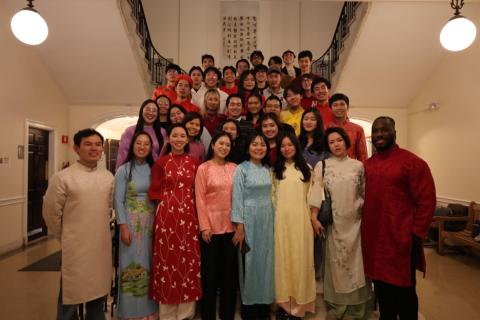
Members of the Harvard Vietnamese Association and Vietnamese Language Table celebrate Tết (Lunar New Year) on February 17, 2026, in the Yenching Institute Common Room, marking the occasion with community, cultural traditions, and shared language. Photo courtesy of Stephanie Nguyen ’27.
For many of its members, the Harvard Vietnamese Association (HVA) is less a club than a home base. Former Co-President Kerry Minh Nguyen ’26 frames its mission simply: to “highlight and exemplify Vietnamese culture to the greater Harvard community,” and to stay grounded in a community that is “welcoming and caring” with a shared goal of spreading Vietnamese culture on campus. From first-generation immigrants to students just discovering their heritage, HVA has become a space where Vietnamese and Vietnamese American identities can be explored, affirmed, and celebrated together.
That sense of home feels especially powerful for students who grew up far from large Vietnamese communities. Stephanie Nguyen ’27, who was raised in rural Texas and Arkansas, remembers being “the only female Vietnamese student” in school and not speaking much Vietnamese at home. She did not celebrate Tết (Lunar New Year) or eat a wide range of Vietnamese food growing up, so arriving at Harvard and stepping into HVA felt like a cultural awakening. After starting out in public relations for the board and later running for Co-President, she describes HVA as “genuinely… my second home,” a place where most of her closest friends were made and where her Vietnamese improved so much that her mother now comments on it when they talk.
For Thu Le ’26, a Co-President and first-generation immigrant from Vietnam, that feeling of continuity is central. She attended her first HVA event during Visitas and has been on board every semester since. Through all the changes of college life, she says HVA “has remained my constant” and “steady comfort and rock.” At its core, she believes, HVA “strives to cultivate a welcoming community to all identities on campus, regardless of whether one is Viet or not,” where everyone can “mutually learn about and celebrate all of the multifaceted aspects of Viet culture.”
That culture comes to life through HVA’s signature events. Members repeatedly point to Tết and Tết Trung Thu (Mid-Autumn Festival) as defining traditions. K. Nguyen calls Lunar New Year “arguably, the most iconic HVA event,” where members wear áo dài and partner with Kirkland House and other cultural groups to share food and customs around a shared celebration. S. Nguyen highlights how HVA collaborates with the Vietnamese Language Program, whose professors prepare homemade dishes, while Le emphasizes Tết as a way for Vietnamese families “all around the world… to close out one year and leave any unwanted negativity behind while ringing in and wishing for a prosperous new year ahead.”
Additionally, food sits at the heart of their storytelling. K. Nguyen calls it “the best gateway into Vietnamese culture because good food is, well, good food,” a way to introduce “more niche Vietnamese aspects, such as political discourse or arts from smaller regions.” S. Nguyen draws inspiration from language table conversations about the history of bánh mì, while upcoming events, such as Phở Night and bánh mì and coffee study breaks, blend comfort, history, and community building.
Beyond celebration, HVA is also a site of reflection and advocacy. The Political Education and Advocacy (PEA) committee organizes speaker events and film screenings to spark dialogue about Vietnamese history, politics, and diaspora. Through PEA, students have heard from authors and academics and learned about everything from Vietnamese music in the United States after the war to contemporary urban history. Sophomore Phu Ta ’28, a member of PEA, sees HVA as a place where “everyone… has some sort of story that connects to Vietnam,” whether through family, language study, or simply loving the food. HVA’s mission, as he puts it, is “to help each member make sense of their story and help them write the next chapters of it.”
To support that journey, the organization invests in structures of care. There are “sibfam” or gia đình groupings that pair upperclassmen with first-years, bi-weekly community dinners in Adams House, monthly study breaks, and an active Slack to keep members connected. Across different regions, generations, and levels of familiarity with Vietnamese culture, HVA leaders share a common philosophy: lead with curiosity and empathy, without assumptions about what it means to be Vietnamese. For them, there is no single definition of Vietnamese identity, only a growing and evolving community that makes room for every story.
–
Founded to celebrate and uplift Vietnamese culture on campus, the Harvard Vietnamese Association (HVA) serves as a home for Vietnamese, Vietnamese American, and allied students at Harvard. Committed to fostering community and cultural visibility, HVA hosts a variety of events throughout the year—from festive Tết and Mid-Autumn celebrations to political education forums, food-centered gatherings, and mentorship programs that connect members across years. Through these cultural and community-building initiatives, HVA continues to create space for students to explore identity, share stories, and celebrate the richness of Vietnamese heritage at Harvard. For more information and to get involved, visit HVA here.
In the coming weeks and in anticipation of Harvard’s Southeast Asian Visibility Week (April 23-25, 2026--more details coming soon!) Asia Center This Week is excited to highlight some of the student organizations with whom we’ve worked closely.