



Southeast Asia Visibility Week Brings Region’s Voices to the Forefront at Harvard
Southeast Asia Visibility Week Brings Region’s Voices to the Forefront at Harvard
By Laurinne Eugenio ‘26
In a campus better known for its global reach than its regional depth, a coalition of students, faculty, and language instructors is working to shift the map, one performance, poem, and plate of food at a time.
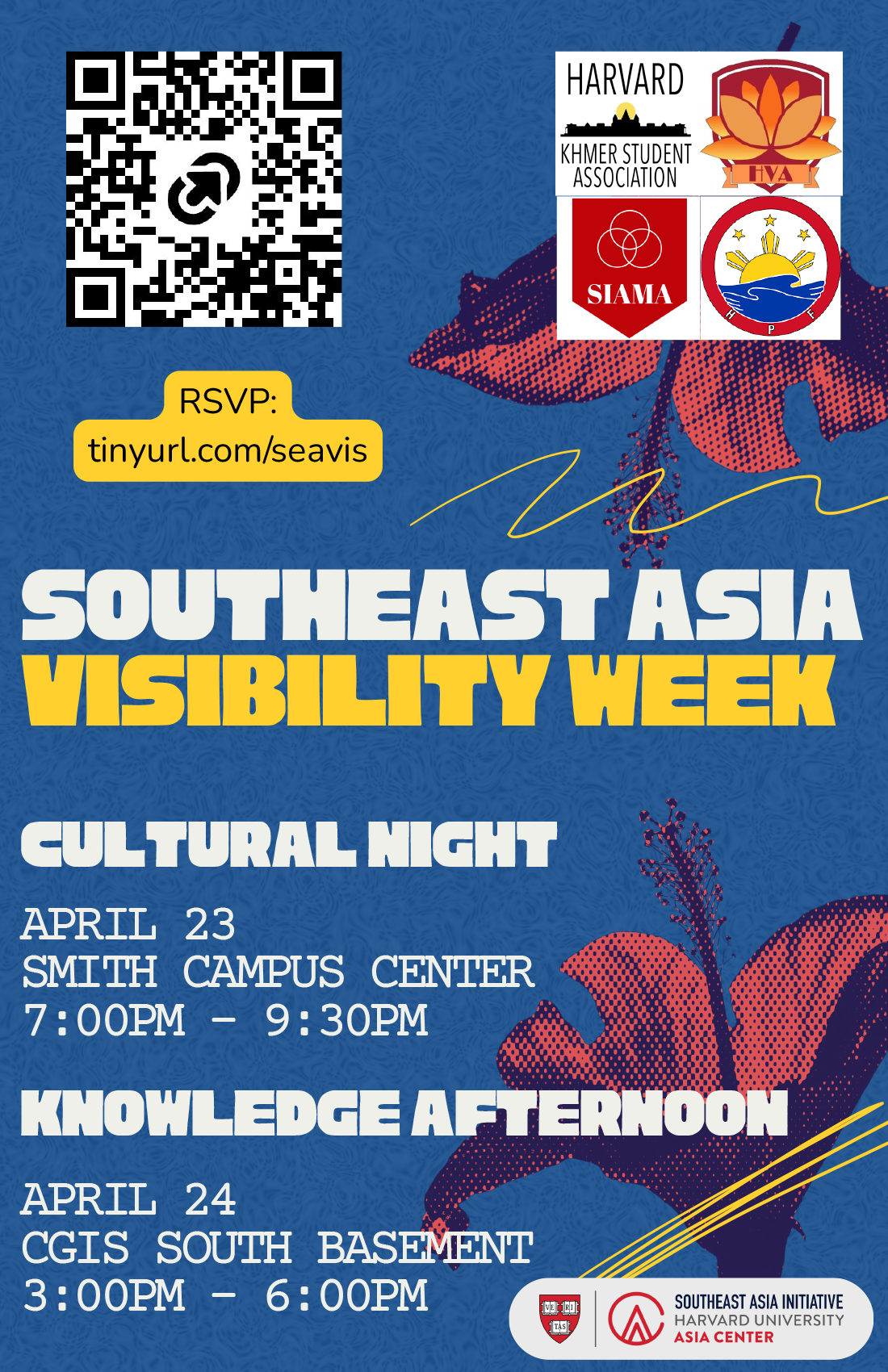
This year’s Southeast Asia Visibility Week will take place on April 23-24, Thursday and Friday, bringing together Harvard students and educators for two days of performances, research, food, and community-building. Organized by the Harvard Vietnamese Association (HVA), Harvard Undergraduate Philippine Forum (HUPF), Khmer Students’ Association, and the Singapore, Indonesia, and Malaysia Association, the week is designed to spotlight a region that is often overlooked in broader conversations about Asia.
For organizer Shayna Leng ’27, the week is about more than programming. It is about building solidarity across Southeast Asian student communities and increasing awareness across Harvard. “Southeast Asia Visibility Week is about building solidarity across the many student communities connected to the region,” she said. “We wanted to create a space that recognizes both the diversity amongst the Southeast Asian countries and the value of thinking about the region collectively.” Her vision is as personal as it is institutional. “This is my love letter to the Southeast Asian community at Harvard.”
That sense of purpose is shared across the coalition. For Phu Ta ’28 of HVA, visibility means resisting flattening and stereotypes. “It primarily comprises two things,” he said, referring to representation that reflects Southeast Asia’s diversity and recognition of the region’s histories, languages, and identities. He added that the week matters because Southeast Asia is often overlooked, both on campus and in wider narratives about Asia. “Participating in SEA Visibility Week could change that,” he said.
The week’s programming reflects that commitment to nuance. Thursday’s Cultural Night at the Smith Campus Center will feature traditional dance, singing, a fashion show, poetry readings, and a catered Southeast Asian dinner. Friday’s Knowledge Afternoon at CGIS South will bring together thesis presentations, a Southeast Asia trivia game, and tea with regional snacks and desserts. Together, the two events are meant to create what Leng described as a balance between “a high-energy event with lots of performances” and “a more relaxed and academic setting.”
For Chantel De Jesus ’28, co-president of HUPF, the week is also about ensuring Filipino voices are seen and heard. She said the core mission is to uplift Southeast Asian students on campus and showcase their cultures to a wider audience. “Visibility means broad awareness of the vast number of cultures, languages, and communities within Southeast Asia,” she said. This year, HUPF will present Tinikling and a post-performance workshop, while also helping source Filipino food for the festival. De Jesus said the biggest challenge is simply finding enough volunteers for an event of this size, especially when student organizations differ in size and capacity.
Faculty and language instructors have been central to turning that vision into a public-facing celebration. Sakti Suryani, preceptor in Indonesian language, organized student performances that connect classroom learning with community participation. She worked with students on poetry readings, including selections from the work of Sapardi Djoko Damono, and helped coordinate performances of Indonesian songs and traditional dance through Boston Cendrawasih. “I want to serve as a bridge between the local Indonesian community, the Harvard Indonesian Students Association, and my students,” she said. Her goal is to make Indonesian culture more visible while encouraging the Indonesian language program to grow.
Kalyarat Tutrone, Thai language instructor, said her students spent extra time outside class preparing for poetry readings because many are still learning to read Thai. She described the week as “a wonderful event that allows people to engage with one another while promoting not only Thai culture, but Southeast Asian cultures as a whole.” Tutrone is especially excited about the Songkran celebration, which she said gives students and community members a chance to create their own New Year tradition together at Harvard.
The Vietnamese language faculty also played a major role in shaping the week. Dr. Hoa Le, Senior Preceptor in Vietnamese and Director of the Vietnamese Language Program, said planning has been deeply collaborative with HVA and the SEA Visibility Week organizing board. She and her colleagues helped invite research presenters, support Vietnamese-language poetry readings, and connect coursework to public programming. Students in intermediate and advanced Vietnamese classes translated and practiced poems by Hàn Mặc Tử and Xuân Diệu for Cultural Night. “We hope that Visibility Week will bring together the growing community of students and scholars on campus,” she said, adding that the week should help foster “a stronger sense of belonging.”
Vietnamese instructors Quang-Nhan Nguyen and Thu Vo echoed that educational goal, noting that the programming allows students to extend classroom learning into a public cultural setting. They also emphasized the intellectual range of the week, especially the Knowledge Afternoon, which will feature research and encourage dialogue across disciplines. “Our motivations stem from both an educational commitment and a deep appreciation for the richness of Southeast Asian cultures,” they said. “Visibility Week provides a meaningful platform to amplify their voices.”
Lady Aileen Orsal, Filipino (Tagalog) language preceptor, said her role is mostly to facilitate student participation in poetry readings and research presentations, but she sees the week’s larger value in the collaboration itself. “When we do things together, we don’t just share our resources,” she said. “We develop that bond or shared connection that makes us more interested, more invested, more excited to learn about each other’s cultures.” She is especially excited that this year’s poetry reading will expand beyond Tagalog to include Cebuano, Ilokano, and Bikol. “It’s a celebration of Southeast Asian languages and cultures, and it is for everyone,” she said.
Across all the interviews, one theme comes through clearly: visibility is not just about being seen, but about being seen accurately. “There is no ONE Southeast Asian culture,” Phu said. Leng put it even more directly: “Southeast Asia is not a footnote. It is a region of extraordinary diversity, creativity, and intellectual importance.”
That idea is also visible in the new additions to this year’s program. Leng highlighted the Southeast Asia Knowledge Afternoon as a new initiative, while Phu pointed to an object gallery featuring toys, jewelry, art, clothes, and souvenirs that carry personal meaning for students. “Everyone has a story to share,” he said, “and our object gallery will be our way of sharing that.”
The week also extends beyond the classroom and campus. Suryani encouraged people to engage with Southeast Asian culture in everyday ways, whether by trying Indonesian, Vietnamese, Thai, or Filipino food, learning a new language, or taking a class about the region. De Jesus similarly emphasized action beyond attendance, while Leng pointed to the Southeast Asia Initiative’s mailing list as a way to stay connected to future programming.
What emerges from these efforts is not a single narrative, but a collection of them. There are students reading poetry, faculty linking coursework to performance, organizers solving logistical challenges, and community members finding each other through food, language, and shared histories. Together, they are building a week that insists Southeast Asia deserves attention on its own terms.
We hope to see you at the following events!
RSVP at tinyurl.com/seavis.
🎭 Cultural Night
When: Thursday, April 23 | 7:00 PM – 9:30 PM
Where: Smith Campus Center, Harvard Commons
Come experience the rich traditions of Southeast Asia! The night will feature:
Performances: Traditional dance, singing, and a stunning fashion show.
Poetry Readings: Readings by students in the Indonesian, Vietnamese, Filipino and Thai language programs.
Food: A full spread of delicious Southeast Asian dinner (catered food!) Think adobo, lumpiang shanghai, pancit bihon, chicken and beef sticks, jackfruit sticky rice dessert, banh xeo, banh beo, kem flan, curry puff, nasi lemak.....
📚 Knowledge Afternoon
When: Friday, April 24 | 3:00 PM – 6:00 PM
Where: CGIS South, Basement
Dive into the region's diverse history and contemporary issues:
Academic Showcase: Thesis presentations focused on Southeast Asian research.
Trivia: Test your knowledge in our Southeast Asia Trivia Game for a chance to win some excellent prizes!
Tea Time: Enjoy Southeast Asian tea paired with traditional finger foods and desserts. Think meat skewers, canh ga chien don, jackfruit sticky rice, sapin sapin, ube biko, leche flan, curry puffs...
Co-organized by: Harvard Vietnamese Association (HVA), Harvard Philippine Forum (HPF), Singapore, Indonesia, and Malaysia Association (SIAMA), and Khmer Students Association (KSA). Generously sponsored by the Harvard Asia Center.