



Talia Andrei Discusses Sacred Journeys and Institutional Rivalries: Pilgrimage Mandalas and the Art of Fundraising in Medieval Japan
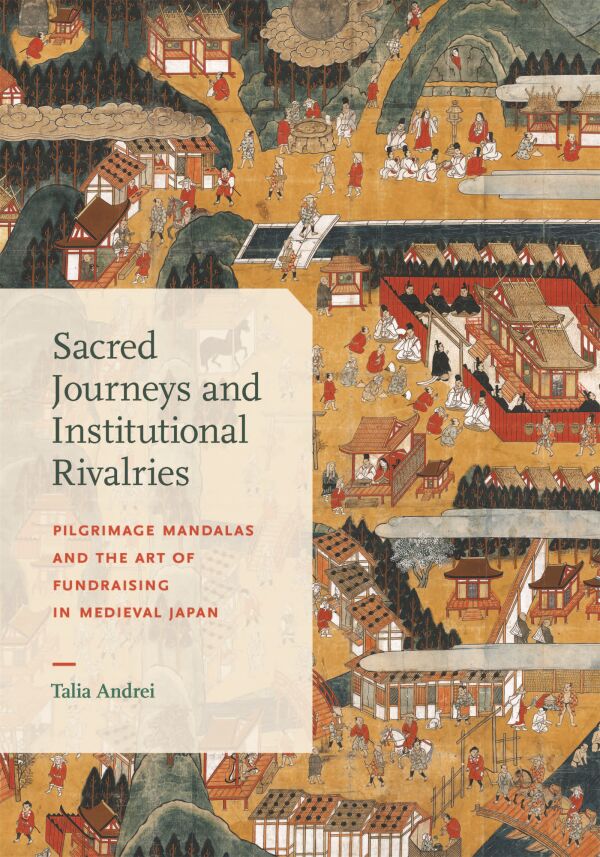
In advance of next week's Asia Center Author Book Talk, author Talia Andrei discusses the book Sacred Journeys and Institutional Rivalries: Pilgrimage Mandalas and the Art of Fundraising in Medieval Japan in the interview below. Join us for her virtual talk Wednesday, October 21, 12:00-1:15 p.m. ET.
Could you give us an overview of your book? My book examines the origins and development of the pilgrimage mandala genre in late medieval and early modern Japan. These large-scale paintings present sweeping aerial views of sacred sites, the pilgrimage roads leading to them, and the pleasures and entertainments awaiting visitors in the surrounding towns. They are populated by pilgrims, religious practitioners, and local residents moving through shrine-temple grounds, along roads, and through bustling towns. Itinerant monks and nuns used the paintings in etoki, or picture-explanation performances, to promote pilgrimage and solicit donations for the sacred sites depicted.
Through close visual and comparative analyses of pilgrimage mandalas associated with four sacred sites, I show that these paintings provide invaluable information about a range of subjects that are sometimes absent from the written record, including sectarian networks, institutional tensions, religious activities, and ritual practices. I therefore read the mandalas as primary sources that can enrich, complement, and sometimes complicate our understanding of the past.
What drew you to this area of research? The paintings. I find them captivating and completely absorbing. Each one contains so many layers and reference to stories, places, people, and religious practices. When I first encountered the mandalas in graduate school, I wanted to learn more about them but quickly realized that very little research had been done on the genre, particularly from an art historical perspective. In an attempt to answer the many questions I had about the mandalas, I decided to make them the subject of my dissertation, and that dissertation eventually became this book.
What was the question (or questions) that drove the creation of this book?
If I had to narrow it down to a single question, it would be: What can these paintings tell us about the histories of the sites they depict and the people who made and used them?
If you had to distill it, what’s the central argument or theme readers should take
away? The central argument I hope to convey to readers is that pilgrimage mandalas can be read like texts. Like historical texts, they present particular, often partisan views of the sites they depict. They should therefore be read closely and critically, both with and against the written archive. Reading them in this way can reveal new perspectives on the past that might otherwise remain invisible.
How did you structure the research in this book? (chronologically, by theme, etc.) How did you decide to structure this way? I begin with a chapter on the origins of pilgrimage mandalas, which I locate in a range of earlier and contemporaneous painting genres. The four chapters that follow each focus on the pilgrimage mandalas associated with a single sacred site: Mt Fuji, Ise Grand Shrine, Kiyomizudera, and Chōmeiji. Each of these sites is unique, with its own legends, history, topography, and religious practices, yet their pilgrimage mandalas are immediately recognizable as part of this distinctive genre. At the same time, close comparative analysis reveals subtle but meaningful differences among the mandalas of each site. I chose this structure to demonstrate how much we can learn by studying a single site and its mandalas in depth, while also showing how the approach I take in these chapters can be applied to other pilgrimage mandala sites as well.
What was the most challenging part of the research or writing process?
One of the most challenging, but also fun and rewarding, parts of the process was arranging special viewings of the mandalas, which are held in museum, temple, and shrine collections throughout Japan, as well as traveling to visit the sites themselves and using the associated mandalas to navigate the grounds. Another challenge was locating and working through the primary and secondary sources related to each site, a process that could be utterly frustrating at times but deeply fulfilling at others.
Who do you imagine as the audience for this book? I imagine the primary audience for the book will be scholars and students of Japanese art, culture, history, and religion, as well as readers with a general interest in Japan, pilgrimage, visual and material culture, or the history of religion more broadly. I also hope it will appeal to readers interested in how images can serve as historical sources and what they reveal about the people and communities who made and used them.
What do you hope readers will be thinking about after finishing it?
I hope readers will come away with an appreciation for the beauty of these mandalas, and that this will encourage them to seek out other forms of art that have traditionally received less scholarly attention. I also hope they will think about how visual sources can be used to recover histories and experiences that textual sources do not fully capture, and that this will prompt them to linger a little longer over the details of works of art and consider what they might reveal.
Do you have any stories from the process—fieldwork, archival finds, or even how you chose the title/cover—that might give readers a glimpse of how the book took shape?
I did a lot of fieldwork for this project. My husband (then boyfriend) and I biked part of the Saikoku pilgrimage circuit, a network of thirty-three temples devoted to the bodhisattva Kannon, with an old iPad loaded with scans of pilgrimage mandalas. At each site, we used the mandalas to navigate the shrine-temple precincts, taking notes about spatial layout, legibility, ease of navigation, and accuracy, and asking whether the paintings could actually function as maps of the site.
We also climbed Mt. Fuji in the middle of the night to watch the sunrise when I was four months pregnant with my first child. Years later, as a family of four, we visited Chōmeiji, each of us equipped with a pen and a large printed mandala, and once again used the paintings to guide us up the mountain and around the temple complex. During that visit, the abbot happened to see us and came over to ask what we were doing. When I explained my research, he told me that four of the Chomeiji Pilgrimage Mandalas were held in the museum at the foot of the mountain and offered to call the curator to arrange a private viewing. The viewing took place the very next day. The curator then introduced me to the head of Shiga Prefecture’s Cultural Properties Division, who sent me a copy of the Chōmeiji komonjo-tō chōsa hōkokusho, a collection of transcribed historical documents related to Chōmeiji and its fundraising. I had been searching for this publication for some time but had been unable to locate or purchase a copy. It was these kinds of adventures and fortuitous encounters that made the research process for this project so exhilarating.