



Forests in Flux: A Botanist's Journey Through Southeast Asia's Changing Landscapes
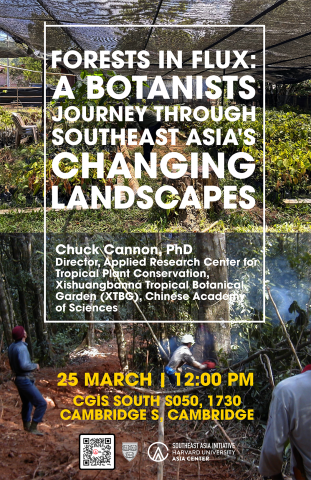
Chuck Cannon, PhD
Director, Applied Research Center for Tropical Plant Conservation, Xishuangbanna Tropical Botanical Garden (XTBG), Chinese Academy of Sciences
Abstract:
Southeast Asia's rainforests are a global hotspot for plant diversity, a dynamic theater of evolution inspired Alfred Russel Wallace's revolutionary letter to Charles Darwin. But now during the Anthropocene, an era where human influence is reshaping the landscapes and climates, plant conservation is experiencing a profound shift. Instead of preserving species and ecosystems, we must safeguard the dynamic, evolving processes that allow forests and their inhabitants to adapt to an uncertain and unprecedented future.
In this talk, Dr. Cannon will explore this challenge by tracing his own path from a Harvard student of biological anthropology to a botanist working across the region and disciplines. It's a journey that began with a year spent studying primates in the forests of West Kalimantan, Indonesia, where he had a simple but powerful realization: you cannot have primates without a forest. This insight changed his focus to the trees that form the architecture and environment of forests.
Over the next three decades, his work took him from Indonesian Borneo, through eastern Malaysia, and the unique island of Sulawesi to the tropical forests of China and Myanmar. He will share how his professional goals evolved in tandem with the landscapes he studied, leading him back to Xishuangbanna Tropical Botanical Garden (XTBG) in tropical Yunnan. First introduced to botanical gardens at XTBG in the late 2000s, he has just returned to lead the new Applied Research Center for Tropical Plant Conservation. Xishuangbanna is a place where biodiversity and culture blur the lines of national borders and bringing it close to Southeast Asia, in general.
Blending personal narrative with scientific insight, Dr. Cannon will discuss the major efforts underway to document and protect the region's vastly understudied flora. He will argue that conserving this heritage isn't just about saving plant species, but about understanding and protecting the very processes of diversification and adaptation that Wallace first glimpsed. For these efforts to be successful and mutually beneficial for humans and plants, that understanding must be framed realistically within the context of human cultural and economic diversity.
Wednesday, March 25, 12:00 p.m., Room S050, Concourse Level, CGIS South Building, 1730 Cambridge Street, Cambridge
Please contact Jorge Espada at jorge_espada@harvard.edu with any questions.