



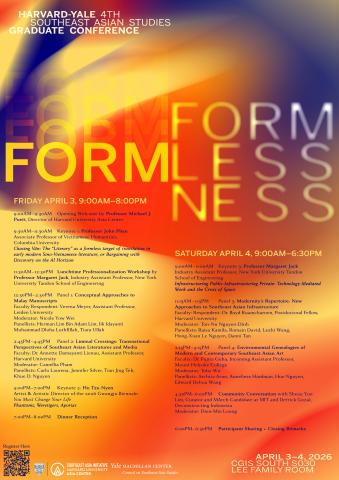
Harvard-Yale 4th Southeast Asian Studies Graduate Conference 2026
PLEASE REGISTER BELOW FOR THE KEYNOTE LECTURES AND PUBLIC DINNER RECEPTION.
HARVARD-YALE SOUTHEAST ASIAN STUDIES GRADUATE CONFERENCE 2026: FORM/FORMLESSNESS
Keynote Lectures
JOHN D. PHAN, Chasing Văn: The "Literary" as a formless target of translation in early modern Sino-Vietnamese literature, or "Bargaining with Discovery on the AI Horizon
APRIL 3, 9.30-11.30 am
Over the 17th and 18th centuries, Vietnamese intellectuals began increasingly to translate Literary Sinitic texts into vernacular Vietnamese using the modified sinographic script known as Chữ Nôm 𡨸喃. This biliterate tradition, rooted in explanatory metatextual commentary, developed into a form of "translation" that all but abandoned linguistic faithfulness as a goal. The form and content of the original no longer guided the translation. Instead, a moving target of literary interest became the object of translation, resulting in the emergence of a new literary voice, housed in a transfigured vernacular language. This process may suggest that there is nothing fixed in the practice of translating from one language into another, or perhaps that what is translated is a matter of positionality and relations. However, I contend that what Vietnamese early modern translation shows us is that it is the specificity of form that was rejected as an object of translation, precisely because languages are inherently systems with definite forms. So to translate from one defined form into another, the translator must ultimately abandon the goal of a defined form. Like the ineffability of the Đạo 道, the target of translation exists—it is real, its effects are tangible, it contains meaning—but it cannot be contained within a single form, or expressed in a single language. This object—the Literary or Văn 文—must be captured by abandoning the effort to faithfully reproduce the formal specifics of the original language. In this talk I will also turn to the issue of intellectual discovery in an age of AI, wherein we increasingly mistake AI or LLMs as producing thought, when in fact, it is merely reproducing simulacra of forms. I will discuss the power of AI to enhance intellectual inquiry, alongside this exact danger of AI, to relinquish our very capacity for true scholarly discovery.
John D. Phan is a language historian focused on the ways in which the history of spoken language, literary language, and writing systems can reveal social, cultural and political realities of the premodern and early modern worlds. His first book, entitled Lost Tongues of the Red River: Annamese Middle Chinese & the Origins of the Vietnames Language, focuses on the history of Sino-Vietic linguistic contact, and is forthcoming from Harvard Asia Center Press. His second project focuses on the vernacularization of early modern Vietnamese society, as exemplified by a vigorous practice of translation from Literary Sinitic into vernacular Vietnamese over the 17th -18th centuries, amidst the sociopolitical regionalization of that period. In addition to the nature of linguistic contact, and broad issues in linguistic change and historical phonology as they pertain to broader historical issues, he is keenly interested in the cultural and intellectual ramifications of multiple languages coexisting in single East Asian societies, of linguistic pluralism in general, and of the transformation of oral languages into written literary mediums in historically diglossic cultures of East and Southeast Asia.
HO TZU NYEN, Phantoms, Weretigers, Aporias
APRIL 3, 5.00-7.00 pm
Ho Tzu Nyen reflects on two decades of moving-image practice through a series of interconnected projects grounded in the history of Southeast Asia—a region never unified by a single language, religion, or political power. Across this body of work, his practice has undergone continuous conceptual and geographical reframing, alongside shifts in form and method: from early lens- and camera-based productions to found footage, 2D and 3D animation, virtual reality, algorithmic editing, and, more recently, AI-driven processes.
The session begins with an introduction to an unfinished feature film from 2011, Endless Day, set in the final days of the Second World War in a tropical forest that could be Singapore or Malaysia. The film follows four groups: the occupying Japanese army; a pair of British Special Forces agents left behind during the colonial retreat; Communist guerrillas imagining a postcolonial future; and a trio of figures drawn from local animistic cosmologies, including a shamanistic weretiger.
These figures would persist as phantoms across Tzu Nyen’s later projects, beginning with the long-term, multi-part work The Critical Dictionary of Southeast Asia, and its online iteration, CDOSEA (https://cdosea.org), a filmic dictionary edited in real time by algorithm. This was followed by works exploring the spectral and ambivalent histories of Malayan communism. From 2019, starting with Hotel Aporia, he developed a trilogy on Japanese intellectual history during the period of Japan’s invasion and occupation of Southeast Asia—an event that, for the first time, synchronized the region’s disparate trajectories and helped shape its modern identity.
Since 2025, he has been working actively with AI in the construction of new works, returning once more to Endless Day. In this lecture, Ho Tzu Nyen reflects on the interweaving of concepts, technical processes, and experimentation that has shaped his practice over the past two decades.
MARGARET JACK, Infrastructuring Public-Infrastructuring Private: Technology-Mediated Work and the Crisis of Space
APRIL 4, 9.00-11.00 am
Our spatial lives are in flux. Where we do paid and unpaid work are increasingly blurred; our social lives blend virtual and brick-and-mortar spaces in new ways. The boundaries between the realm of the public and the realm of the private are seemingly less clear. In this talk, I build on infrastructure studies, particularly the work of Susan Leigh Star, who describes how infrastructures are put into action through work, or infrastructuring. Using cases from Phnom Penh, Cambodia, and New York City, I empirically describe the breakdown of spatial norms with the emergence of new forms of technologically-mediated work. Using the case of gig workers, I describe what I call infrastructuring public: how gig workers are pushed into the public realm (the street) and are responsible for making their work happen and their lives work - often at risk to their safety. As popular deliberation about these new forms of work shifts into questions of space, I suggest we make obdurate the politics of the platforms on which this work runs. Using the case of independent creative workers, I then describe what I call infrastructuring private: how remote workers are increasingly closed off into private spheres (the home) and are responsible for cultivating a workplace within their intimate lives. These trends encourage a crisis of housing, workers’ physical pain, and the exacerbation of traditional gender roles and inequalities. In sum, I reiterate the importance of studying relationality within infrastructure, and how this scholarly lineage can continue to provide a useful lens for contemporary forms of work as they move outside of traditional workplaces.
Maggie is an Industry Assistant Professor at NYU Tandon in the Department of Technology, Culture and Society, where she researches technology and work in a global context. Her scholarly work is primarily in conversation with the fields of Science and Technology Studies (STS), Human-Computer Interaction (HCI), and design. In her teaching, Maggie encourages design and engineering students to use humanistic methods and perspectives to critically analyze and imagine futures for the impacts of technology on society. Maggie holds a PhD in Information Science from Cornell University, an MPhil in the History and Philosophy of Science from the University of Cambridge, and a BA in History and Science from Harvard College. In previous lives, she worked in the international development sector and as a financial analyst in the technology-media-telecom sector in Silicon Valley. Her first book Media Ruins: Cambodian Postwar Media Reconstruction and the Geopolitics of Technology charts the critical role of media in the historical political landscape of Cambodia as well as in its post-conflict reconstruction and reconciliation.
Panels
Conceptual Approaches to Malay Manuscript Studies
Faculty Respondent: Verena Meyer, Assistant Professor of Islam in South and Southeast Asia at Leiden University
Moderator: Nicole Yow Wei, PhD Student in History and Early Modern Studies, Yale University
Panelists: Herman Lim Bin Adam Lim, Iik Idayanti, Muhammad Dluha Luthfillah, Tiara Ulfaha
April 3, 12.30-2.30pm
This panel brings new conceptual momentum into the undertheorised field of Malay literary and manuscript studies. A fresh focus on Form and Formlessness interrogates the social lives of Malay texts beyond questions defined by traditional analytical bibliography. The papers presented consider how form and meaning entwine on the level of the word, genre, and indeed reality itself.
Liminal Crossings: Transnational Perspectives of Southeast Asian Literatures and Media
Faculty Respondent: Annette Damayanti Lienau, Associate Professor of Comparative Literature, Harvard University
Moderator: Camellia Pham, PhD Student in Comparative Literature, Harvard University
Panelists: Jennifer Silver, Carlo Laurena, Khue D. Nguyen, Tian Jing Teh
April 3, 2.45-4.45pm
In sustained dialogue with Benedict Anderson’s formulation of the nation as an imagined community, the parameters of the national have been substantially rethought, no longer reducible to homogeneous temporality and territorialized spatiality. All the more pronounced is this dynamic in Southeast Asia, a region imagined not through origin but through derivation from the outset, constituted in and increasingly inflected by transnationality (Chittiphalangsri and Rafael, 2023). Its crossings traverse indeterminate, loosely bounded geographies that exceed continental frames and resist stable taxonomies.
More than a transitional state, this panel takes the liminal as a permanent epistemological and political condition, one whose very instability demands critical languages adequate to its irreducible entanglements. Working in the register of minor transnationalism (Lionnet and Shih, 2005), the papers assembled here refuse the vertical, center-to-margin logics of globalization. They instead attend to lateral networks of traversal, at once centripetal and centrifugal, through which minoritized subjects—migrant writers, diasporic communities, colonial witnesses, postcolonial artists—produce culture, propose routes of interpretation, and articulate unlikely solidarities and forms of belonging that exceed the often-anchored explanatory capacities of the nation-state.
Modernity’s Repertoire: New Directions in Southeast Asian Infrastructure Studies
Faculty Respondent: Dr. Boyd Ruamcharoen, Postdoctoral Fellow in the Charles Warren Center for Studies in American History
Moderator: Ton-Nu Nguyen, PhD Student in History, Columbia University
Panelists: Raisa Kamila, Romain David, Lezhi Wang, Hong-Xuan Le Nguyen, Danni Tan
April 4, 11.15am-1.15pm
Echoing Marcus Yee and Nicole Yow Wei’s provocations in 2024 to reconsider the category of Southeast Asia, and to examine Southeast Asian case studies as theoretical interventions, this panel explores the concept of “modernity’s repertoire” as a set of practices and processes that shaped modern Southeast Asia. The panelists selected respond to the keyword “infrastructure”, each highlighting in their case study a particular dimension of environmental governance and society building in modern and contemporary Southeast Asia. Each panelist explores a different kind of environment – from the natural landscape to visual and built environments, and a different society: modern Vietnam and Thailand, and colonial Singapore, Borneo (Malaysia and Indonesia), and Sumatra (Indonesia). What kinds of infrastructure existed in these places from the colonial era until today? What counts as infrastructure? How might we frame Southeast Asian modernity and its emergence through extant materialities? What are new, possible approaches to the study of everyday life in modern Southeast Asia? Following panelists’ presentations is a round-table discussion of these questions.
Environmental Genealogies of Modern and Contemporary Southeast Asian Art
Faculty Respondent: Dr. Pujita Guha, Mahindra Center Postdoctoral Scholar and Incoming Assistant Professor at Mount Holyoke College.
Moderator: Toby Wu, PhD Student in Art, Film and Visual Studies, Harvard University
Panelists: Anneliese Hardman, Edward Dehua Wang, Nguyen Thi Hue, Archita Arun
April 4, 2.15-4.15 pm
“Uncontainable, Ungovernable, and Irreducible”—Southeast Asian Art Historians have underscored the indignant and seemingly unruly persistence of artistic practice emerging from our region, namely against the classificatory mandates of imperial warfare, extractive economies and ongoing (neo-)colonialisms (Davis, Chua, Taylor, 2021). Part of this persistence lies in working through the inseparability of nature-cultures, in which our vernacular living with(in) these ecologies allows for an non-exceptionalist positioning of anthropocentric artistic activity (Ray and Venogupal, 2019). How do we begin to figure the ecologies of artistic practice in relation to one’s environment? How do the emplaced boundaries of area studies delimit the forms and formations one can observe in practice?
The papers in this panel engage methodologies from the environmental humanities, performance and cultural studies to progress beyond the dialectics of stylistic representation and conceptual intent—into the onto-epistemological, co-constitutive mattering of artistic practice across the region.
Community Conversation
Interference: What's the Doxa in the Paradoxical?
April 4, 5:00-6.30pm
Sheau Yun Lim, Curator and MArch Candidate at MIT; Derrick Gozal, Co-founder, Deconstructing Indonesia; moderated by Dien-Min Loong, PhD student in History, Yale University and President, Imagined Malaysia
Southeast Asia is a site where activism, art, and intellectual dissent survives in informal, encrypted, or unstable forms to remain tenable. The slippage of structure, order, and convention is both a symptom and response to Southeast Asia’s geopolitical climate. An active resistance against legibility and form is critical for intellectual work to sustain itself in authoritarian regimes that mark the region. The community conversation brings curator, architect and writer Lim Sheau Yun, educator Derrick Gozal, and public humanities practitioner Loong Dien Min to discuss how public programming foregrounds political advocacies that interrogates globalization’s contradictions: its expansion of international interconnection, and its entanglement with neoliberal developmentalism and ethnonationalist state-building, which together intensify forms of exclusion and national isolation. The conversation interrogates emergent and shapeshifting epistemic and political forms in Southeast Asia, those at the margins of formal academic or political representation. Together, the conversation probes reflections on the discursive and material forms of power-knowledge: If crisis is the drumbeat of the ordinary in Southeast Asia, how might the blurring, rather than sharpening, of art, academic, and activist methods produce a sustainable ecology of knowledge politics in Southeast Asia?